In this article
- How the System Works
- Why the System Is Needed + Risks of Neglect
- The Maintenance Regime — What, How Often, and How
- Who Is Authorized to Maintain and Certify
- Standards and Regulation
- Required Documentation and Forms
- Common Faults and Warning Signs
- The Value of Professional Maintenance Management / How Domera Helps
- Frequently Asked Questions
- Further Reading
- Frequently asked questions
Aviation Lighting (Aviation Obstruction Light) — The Warning Light Atop the Building
Aviation lighting is the warning light — usually red — installed at the highest point of a tall building to mark it for pilots and aircraft as a physical obstruction in the sky. This is why the system exists: a tall building, crane, or mast is an object protruding into the flight path, and in hours of darkness or poor visibility a pilot may fail to notice it in time; the steady or flashing warning light makes the building visible and prevents a collision.
Part of a bigger picture: this system is one component within a complete preventive maintenance program. For the full framework — all systems, frequencies, authorized parties, and forms — see the complete PPM guide.
For a building manager or maintenance engineer, this is a system that is special in two ways: it is located at the least accessible point of the building — the roof and the top of the mast — and a fault in it is almost never noticed from below. But exactly like any invisible safety system, its value is revealed only when someone needs it, and here the "someone" is a pilot passing overhead. In this article we explain how the system works, why it is needed specifically in tall buildings, what the required inspection regime is in Israel, who is authorized to inspect and certify it, and which documents must be kept.
Part of a bigger picture: aviation lighting is one component within a complete preventive maintenance program. For the full framework — all systems, frequencies, authorized parties, and documents — see the complete PPM guide.
How the System Works
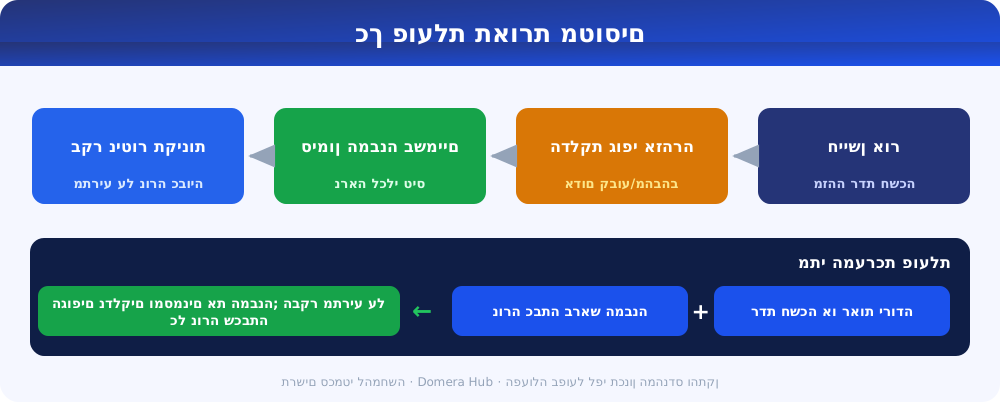
At its core, aviation lighting is an array of dedicated light fixtures installed at the highest and most prominent points of the building — the roof edge, its corners, and the tops of masts or facilities protruding above it. Their sole purpose is to make the building's outline visible to aircraft. The fixtures are built to withstand harsh outdoor conditions — rain, wind, solar radiation, and lightning strikes — because they are located at the most exposed point of the building.
The key to operation is automatic activation by light level: a light sensor (photocell) detects when darkness falls or when visibility deteriorates, and switches on the warning fixtures; at dawn it switches them off. Some systems light a steady light, and some a flashing light — depending on the building's nature, its height, and the guidance of the competent aviation authority. In especially tall buildings, several lighting levels are sometimes installed — at the top of the building and at intermediate heights — to give the pilot a sense of volume and height, and not just a single point.
A third important element is integrity monitoring. Because the fixtures are located where no one routinely sees them, modern systems include a controller that monitors whether each fixture is indeed lit when it should be, and alerts when a lamp has gone out or a circuit has disconnected. In terms of supply, the aviation lighting is part of the building's electrical system, and in tall buildings it is also tied to emergency circuits so that it continues to operate even during a power outage — since the building remains an obstruction in the sky then too.
Why the System Is Needed + Risks of Neglect
The need for aviation lighting arises from the very existence of a tall building: once the building crosses a certain height it becomes a potential aviation obstruction, and the warning light is the means that marks it for aircraft during hours when the eye cannot make it out — night, fog, rain, or poor visibility. This is a system whose benefit is not to the building or its occupants, but to flight safety in its surroundings — and so it is an external requirement the building must comply with.
The risk of neglect is especially severe because the fault is invisible from below:
- A lamp that quietly went out — the common failure. A fixture atop the building that has burned out simply stops shining, and no one on the floors notices. The building remains an obstruction in the sky — but without the marking meant to warn against it.
- A sensor or controller that does not activate the system — a faulty light sensor may fail to switch on the fixtures as darkness falls, so that the entire array stays off precisely during the hours when it is needed.
- Aviation safety risk and non-compliance with the law — the aviation lighting inspection is a statutory requirement for a building of 10 stories or more. A building whose system is not functioning or that has no valid inspection certificate is exposed to a real safety risk (an aircraft colliding with an unmarked obstruction), to legal and insurance exposure, and to difficulty renewing the building's permits with the authorities.
What all these have in common: they cannot be identified without physically going up and checking, or without a monitoring controller that alerts. A tall building that does not maintain a proper inspection may stand for months with an off warning light without anyone in the building knowing about it.
The Maintenance Regime — What, How Often, and How
The mandatory inspection of the aviation lighting is an annual inspection — once a year. In the inspection, the installation points on the roof and masts are physically climbed to, it is verified that every warning fixture is lit as required, the operation of the light sensor and controller is examined, and it is confirmed that there are no burned-out lamps, corroded contacts, or damage caused by exposure to outdoor conditions and lightning. The output of the inspection is an aviation lighting inspection certificate.
- What is checked: automatic switching on and off by light level; that every fixture (at each lighting level) is lit; the integrity of the controller and the alert for an out lamp; the integrity of the structure, wiring, and sealing at the exposed points; and the electrical supply, including the emergency-mode supply where it exists.
- How often: once a year — the periodic inspection that produces the inspection certificate. Beyond the annual inspection, it is recommended to routinely follow the controller's alerts (where one exists) and to immediately replace any lamp that has gone out.
The frequency and applicability details appear in full in the PPM guide. For any technical aspect that has no explicit specification in the binding source — such as the type of fixture, the light intensity, or the manner of flashing — one should rely on the standard and the current guidance of the competent aviation authority and the manufacturer, and not assume a figure or parameter that is not written.
Who Is Authorized to Maintain and Certify
The aviation lighting inspection and the issuing of the official certificate are within the authority of an electrician holding an appropriate license. "An appropriate license" means a license matching the nature of the electrical installation and the required inspection — and it is this that qualifies the professional to sign the aviation lighting inspection certificate.
Because the work is performed at the highest and most exposed points of the building — on the roof and the tops of masts — it almost always involves work at height, and so it must be coordinated with the building's safety arrangements (anchor points, lifelines, and safe access means). It is also advisable to coordinate the aviation lighting inspection with the building's other electrical-installation inspections, in order to concentrate the visits at the hard-to-reach points. When a specific certification detail is not defined in the binding source — one should act per the guidance of the authority and the manufacturer, and not assume a certification that is not written.
Standards and Regulation
The aviation lighting inspection is a legal (statutory) requirement in Israel, and it applies to a building of 10 stories or more. This means it is not a recommendation but an obligation: a tall building is required to hold a valid aviation lighting inspection certificate. The requirement derives from the building constituting an aviation obstruction — and so it is governed by the competent aviation authority, which determines which buildings must be marked, the type of light, and its location.
It is important to note: in the binding sources in our possession, no dedicated SI standard number is specified for aviation lighting, and so we will not cite a specific standard number here. The binding basis is the annual inspection and its certification by an electrician holding an appropriate license, alongside the standard's requirements and the current guidance of the competent aviation authority and the manufacturer. Any further compliance requirement — should be derived from the binding source and not from an invented standard number or clause.
Required Documentation and Forms
The central document that holds the aviation lighting's compliance is the aviation lighting inspection certificate — the output of the annual inspection by the electrician holding the appropriate license. This is the statutory document that must be kept valid, and it is the proof that the building is marked as required toward aircraft.
This system has no dedicated fire form (unlike other electrical systems such as emergency lighting, which is covered by Form 3). Therefore, the aviation lighting inspection certificate should be managed as a live file with an expiry date, and alongside it the list of the warning fixtures inspected and their locations should be kept — so that at the next inspection it is easy to verify that every marking point on the building was indeed inspected and certified. It is recommended to file the certificate together with the building's other electrical-installation certificates, to which it is related in terms of supply and inspection.
Common Faults and Warning Signs
- A burned-out lamp atop the building — the most common and most dangerous fault, because it is invisible from below. A burned-out fixture leaves a "hole" in the building's marking; without a monitoring controller, no one will know until the next inspection or until an external complaint.
- The light sensor does not switch the system on — a dirty, shaded, or faulty photocell may leave the fixtures off as darkness falls, or the opposite — switch them on during the day. Either way, the matching of light level to activation is disrupted.
- No flashing or the frequency has changed — in systems with a flashing light, flashing that has stopped or changed may impair the ability to identify the building as an obstruction.
- Corrosion and weather damage at the installation points — the location exposed to rain, sun, and lightning strikes causes accelerated wear of the fixtures, wiring, and sealing; water ingress or a corroded contact lead to a silent failure.
- The system is not powered during an outage — where emergency supply is required, failure to connect to the emergency circuit means the building remains an unmarked obstruction precisely when the ordinary lighting around it has also gone out.
The Value of Professional Maintenance Management / How Domera Helps
Aviation lighting is a clear example of a system that is easy to neglect — it is located at the least accessible point of the building, and a fault in it is almost never noticed from inside. A single annual inspection, a certificate that must be renewed, and warning fixtures each of which may quietly burn out — all these require orderly tracking and not reliance on "if there were a fault, someone would already have complained." Domera's Knowledge Hub is designed to help the building manager see this picture clearly, especially in a tall building where the obligation applies by force of law.
In practice, in the Domera system the aviation lighting is managed through a preventive maintenance program (PPM): for each inspection one open instance exists at any given moment, and closing it requires attaching the certifying document — the aviation lighting inspection certificate. The system sends reminders before expiry of the certificate, so that the annual inspection is not missed in a system that is easy to forget, and produces compliance reports showing exactly which systems are valid and which are out of date. The idea is simple: to close the loop against the document and the inspection — especially when the system itself is hidden out of sight.
Frequently Asked Questions
What is aviation lighting and why is it important?
Aviation lighting is a warning light (usually red) installed at the highest point of a tall building, marking it for pilots and aircraft as a physical obstruction in the sky. It is important because in hours of darkness or poor visibility a pilot may fail to notice the building in time — and the warning light prevents a collision.
Which buildings does the aviation lighting obligation apply to?
Per the binding source, the aviation lighting inspection is a statutory requirement for a building of 10 stories or more. The requirement derives from a building of such height constituting an aviation obstruction, and is governed by the competent aviation authority.
How often must aviation lighting be inspected?
Once a year. The annual inspection is performed by an electrician holding an appropriate license and produces the aviation lighting inspection certificate. Beyond that, it is recommended to routinely follow the controller's alerts (where one exists) and to immediately replace any lamp that has gone out.
Who is authorized to inspect and certify aviation lighting?
An electrician holding an appropriate license — they are the one authorized to perform the annual inspection and sign the aviation lighting inspection certificate. Because the work is at height, it must be coordinated with the building's work-at-height safety arrangements.
How does the system know when to switch on?
By means of a light sensor (photocell) that detects the fall of darkness or a deterioration in visibility and switches on the warning fixtures, and switches them off at dawn. Some systems light a steady light and some a flashing light — depending on the building's nature and the guidance of the competent aviation authority.
What happens if a lamp atop the building burns out and no one notices?
The building remains an obstruction in the sky without the marking meant to warn against it — an aviation safety risk. Because the fault is invisible from below, only a monitoring controller that alerts, or the annual inspection, will expose it; therefore it is important not to skip the inspection and to follow the system's alerts.
Is there a fire form or SI standard for aviation lighting?
This system has no dedicated fire form, and the binding source in our possession does not specify a specific SI standard number for aviation lighting. The statutory document is the aviation lighting inspection certificate from the electrician's annual inspection, alongside the requirements of the standard and the competent aviation authority and the manufacturer's current guidance.
Which documents must be kept?
The aviation lighting inspection certificate (the statutory document from the annual inspection), with an expiry date. Alongside it, it is advisable to keep the list of the warning fixtures inspected and their locations on the building, and to file the certificate together with the building's other electrical-installation certificates.
Further Reading
- The PPM guide — how to build a complete preventive maintenance program for the building, with all the frequencies, authorized parties, and documents.
- Maintaining the building's electrical systems — the broad background of the electrical array that aviation lighting is part of, including the emergency-mode supply.
- Lightning protection — a sibling system on the building's roof: the same exposed point atop the building, and protection against lightning strikes that also threaten the aviation lighting.
- The Knowledge Hub — all the guides on building systems in one place.
Frequently asked questions
What is aviation lighting and why is it important?
Aviation lighting is a warning light (usually red) installed at the highest point of a tall building, marking it for pilots and aircraft as a physical obstruction in the sky. It is important because in hours of darkness or poor visibility a pilot may fail to notice the building in time — and the warning light prevents a collision.
Which buildings does the aviation lighting obligation apply to?
Per the binding source, the aviation lighting inspection is a statutory requirement for a building of 10 stories or more. The requirement derives from a building of such height constituting an aviation obstruction, and is governed by the competent aviation authority.
How often must aviation lighting be inspected?
Once a year. The annual inspection is performed by an electrician holding an appropriate license and produces the aviation lighting inspection certificate. Beyond that, it is recommended to routinely follow the controller's alerts (where one exists) and to immediately replace any lamp that has gone out.
Who is authorized to inspect and certify aviation lighting?
An electrician holding an appropriate license — they are the one authorized to perform the annual inspection and sign the aviation lighting inspection certificate. Because the work is at height, it must be coordinated with the building's work-at-height safety arrangements.
How does the system know when to switch on?
By means of a light sensor (photocell) that detects the fall of darkness or a deterioration in visibility and switches on the warning fixtures, and switches them off at dawn. Some systems light a steady light and some a flashing light — depending on the building's nature and the guidance of the competent aviation authority.
What happens if a lamp atop the building burns out and no one notices?
The building remains an obstruction in the sky without the marking meant to warn against it — an aviation safety risk. Because the fault is invisible from below, only a monitoring controller that alerts, or the annual inspection, will expose it; therefore it is important not to skip the inspection and to follow the system's alerts.
Is there a fire form or SI standard for aviation lighting?
This system has no dedicated fire form, and the binding source in our possession does not specify a specific SI standard number for aviation lighting. The statutory document is the aviation lighting inspection certificate from the electrician's annual inspection, alongside the requirements of the standard and the competent aviation authority and the manufacturer's current guidance.
Which documents must be kept?
The aviation lighting inspection certificate (the statutory document from the annual inspection), with an expiry date. Alongside it, it is advisable to keep the list of the warning fixtures inspected and their locations on the building, and to file the certificate together with the building's other electrical-installation certificates.