
In this article
- How the system works
- Why the system is needed + risks of neglect
- The maintenance regime — what, how often, and how
- Who is qualified to maintain and certify
- Standards and regulation
- Required documentation and forms
- Common faults and warning signs
- The value of professional maintenance management / how Domera helps
- Frequently asked questions
- Further reading
- Frequently asked questions
Energy Consumption Management — Energy Survey and Annual Reporting
Energy consumption management is the process of systematic measurement, reporting and reduction of a building's power and energy consumption — in order to save costs, reduce the carbon footprint, and comply with the Ministry of Energy's requirements. In Israel, above certain consumption thresholds, this is not merely good practice but a legal requirement: a large building must report its energy consumption annually, and above a higher threshold it must also carry out a periodic energy survey by a certified surveyor.
For a building manager or maintenance engineer, this is one of the few places where regulation, financial savings and ESG converge on the same action. In this article we explain how the mechanism works, what the exact thresholds are that trigger the reporting and survey obligations, how often, who is qualified to perform them, and how to manage it all without missing a submission to the Ministry of Energy.
Part of a bigger picture: energy consumption management is one component in a complete preventive maintenance plan. For the full framework — all the systems, frequencies, qualified professionals and documents — see the full PPM guide.
How the system works
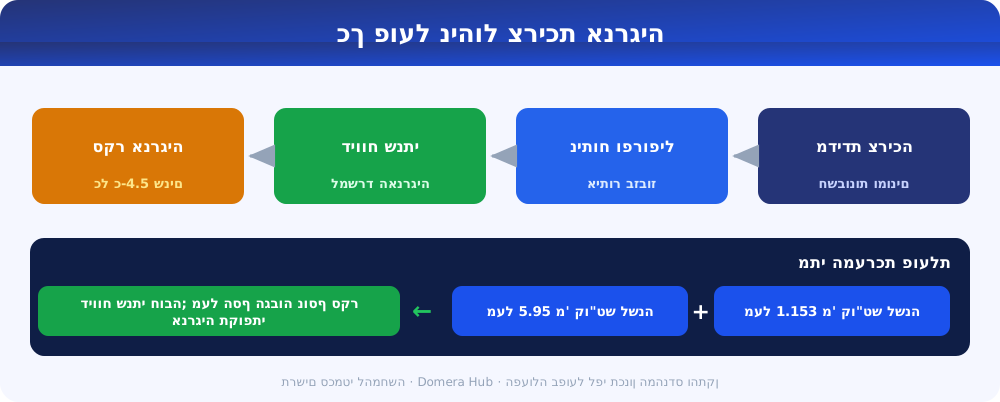
Unlike an engineering system with piping or transformers, the energy consumption management "system" is mainly a process of measurement, analysis and reporting. At its core are several stages:
- Measurement and monitoring. Collecting the building's consumption data — electric utility bills, sub-meters, and sometimes a building management system (BMS) that monitors the large consumers in real time: air conditioning, lighting, elevators and pumps.
- Analysis and consumption profiling. Understanding what consumes energy in the building, when, and where there is waste — peak loads, systems running unnecessarily, savings potential.
- Annual reporting. Above a defined consumption threshold, the building is obligated to report its energy consumption to the Ministry of Energy every year.
- Periodic energy survey. Above a higher consumption threshold, an in-depth energy survey by a certified surveyor is required — a full mapping of consumption and savings recommendations — once every few years.
The guiding idea is measure → understand → reduce: you cannot manage what you do not measure. When the measurement is orderly, the savings come from focused projects — such as upgrading lighting to LED, optimizing the air conditioning, or improving operation control. The report and the survey are the regulatory "output" of that same measurement process.
Why the system is needed + risks of neglect
Energy consumption management is needed for three reasons that connect to one another: money, law and sustainability. Energy is usually one of a building's largest operating expenses, and without systematic measurement it is hard to know where it is being spilled. Above the consumption thresholds in the law, managing consumption also becomes an obligation vis-à-vis the Ministry of Energy.
Neglecting the area creates three types of exposure:
- Law and regulation. A building that exceeds the consumption threshold and does not submit an annual report, or does not carry out an energy survey when it is obligated to, is in non-compliance with a legal requirement vis-à-vis the Ministry of Energy — with exposure to enforcement.
- Financial waste. Without measurement and analysis, systems run unnecessarily, peak loads are unmanaged and the bill is inflated. A good energy survey points to real savings that repay its cost.
- ESG and reputation. Investors, large tenants and green building standards increasingly demand transparency in energy consumption and emissions. A building without orderly consumption data struggles to meet ESG requirements and to compete for quality tenants.
The maintenance regime — what, how often, and how
The energy consumption management system has two distinct periodic obligations, and each is triggered above a different annual consumption threshold:
- Energy consumption reporting — annual (every 12 months). Applies to a building whose energy consumption exceeds 1.153 million kilowatt-hours per year. The report is submitted to the Ministry of Energy, and the document to produce and keep is a Ministry of Energy confirmation of the submission of an annual energy consumption report.
- Carrying out / updating an energy survey — every ~4.5 years (54 months). Applies to a building whose energy consumption exceeds 5.95 million kilowatt-hours per year — a higher threshold. This is an in-depth survey performed by a certified energy surveyor, and the document to produce and keep is a Ministry of Energy confirmation of the submission of an energy survey.
Note the two-tier logic: the annual report applies already from the lower threshold (above 1.153 million kWh) and is carried out every year; the in-depth survey is added only in the very largest buildings (above 5.95 million kWh) and is carried out once every ~4.5 years. Both thresholds and frequencies are taken directly from the requirements matrix — they must not be estimated by guesswork. A small building that does not cross either threshold is not legally obligated to them, but voluntary consumption management still pays off financially and strengthens the ESG profile.
Who is qualified to maintain and certify
The two obligations have separate qualified parties, and it is important not to confuse them:
- Energy survey — performed and certified by an energy surveyor certified by the Ministry of Energy. This is a dedicated qualification; the survey is professional work of consumption mapping, analysis and savings recommendations, and is therefore reserved for the qualification holder alone.
- Annual energy consumption reporting — the responsibility of the officer for the promotion of energy consumption in the organization/building. This is the role that consolidates the consumption data and submits the annual report to the Ministry of Energy.
The practical meaning for the building manager: appoint and clearly define who is the officer for the promotion of energy consumption who submits the annual report, and when the higher threshold is crossed — engage a certified energy surveyor to carry out the survey. Both confirmations ultimately come from the Ministry of Energy, and they are the proof that the obligation was met.
Standards and regulation
Energy consumption management is subject to the supervision of the Ministry of Energy, and the two obligations — the annual report and the periodic survey — are legal requirements (statutory) above the specified consumption thresholds. They apply to every site that crosses the relevant threshold.
It is important to be precise and not to invent: in our requirements matrix there is no unique SI number explicitly directed to the energy consumption management system, so we will not cite a specific standard number here. The binding requirement, as it is documented, is submitting the annual report above 1.153 million kWh and carrying out/updating the energy survey above 5.95 million kWh, vis-à-vis the Ministry of Energy and by the qualified parties. As for the execution details — one must act according to the Ministry of Energy's current directives.
Required documentation and forms
Two documents hold the building's compliance with the requirement, both from the Ministry of Energy:
- Ministry of Energy confirmation of the submission of an annual energy consumption report — the proof that the annual report was submitted. Manage it as a living file with a date, and refresh it every year.
- Ministry of Energy confirmation of the submission of an energy survey — the proof that the periodic survey was carried out and submitted. Valid until the next survey date (in ~4.5 years).
Unlike the fire suppression systems, energy consumption management has no dedicated fire form — so there is no link to a fire form here. Nonetheless it is worth keeping the two confirmations together with the building's energy file, alongside the annual consumption data and survey reports, because from the standpoint of a regulator, an insurer or an investor — a valid confirmation is the proof that the obligation was met. An orderly process of a building energy audit produces exactly this documentation.
Common faults and warning signs
- No one is monitoring the consumption — when no one collects the annual consumption data, the building may cross an obligation threshold without knowing and miss a report.
- An annual report not submitted on time — a breach of a legal requirement vis-à-vis the Ministry of Energy; usually stems from the absence of a defined responsible party.
- An energy survey that has expired and was not renewed — the confirmation is valid for a limited period; a building that crossed the higher threshold and did not renew the survey is in non-compliance.
- A sharp, unexplained jump in the electricity bill — a sign of a fault, a leak or a system running unnecessarily; ongoing measurement reveals it early.
- Survey recommendations that remain on paper — a survey with no follow-through implementation wastes its economic value; the real value is in carrying out the recommendations.
The value of professional maintenance management / how Domera helps
Energy consumption management is exactly the kind of task that falls through the cracks: there is no leaking pipe here to remind you of itself, just an annual submission date vis-à-vis the Ministry of Energy that is easy to forget — until it turns out the building is in non-compliance. The value of professional management is that this obligation does not rest on anyone's memory.
In the Domera system the report and the survey are managed through a preventive maintenance (PPM) plan: for each obligation a single open instance is opened at any given moment, and closing it requires attaching the appropriate Ministry of Energy confirmation — the annual report confirmation or the survey confirmation. The system sends a reminder before validity expires and produces compliance reports that show exactly whether the building is valid or out of compliance. This is how the loop is closed against the document — and no energy report or survey is "forgotten" until the last moment.
Frequently asked questions
What is energy consumption management in a building?
It is the process of systematic measurement, analysis, reporting and reduction of a building's power and energy consumption. Above certain consumption thresholds it includes legal obligations: annual reporting to the Ministry of Energy, and above a higher threshold also a periodic energy survey by a certified surveyor.
From when is a building obligated to report on energy consumption?
The annual reporting obligation applies to a building whose energy consumption exceeds 1.153 million kilowatt-hours per year. The report is submitted to the Ministry of Energy, and a confirmation of the submission of an annual energy consumption report is received for it.
When must an energy survey be carried out and how often?
An energy survey is required in a building whose consumption exceeds 5.95 million kilowatt-hours per year — a higher threshold than the reporting threshold. It is carried out and updated once every ~4.5 years (every 54 months) by a certified energy surveyor.
Who is qualified to carry out an energy survey and who submits the report?
An energy survey is carried out by an energy surveyor certified by the Ministry of Energy. The annual report is the responsibility of the officer for the promotion of energy consumption. Both confirmations come from the Ministry of Energy.
What is the difference between energy consumption reporting and an energy survey?
The report is an annual submission of the consumption data, and applies already from a lower threshold (above 1.153 million kWh). The survey is an in-depth examination with consumption mapping and savings recommendations, applies from a higher threshold (above 5.95 million kWh), and is carried out once every ~4.5 years.
Is there a fire form for energy consumption management?
No. Unlike the fire suppression systems, energy consumption management has no dedicated fire form; the binding documents are the Ministry of Energy confirmations of the submission of the annual report and of the submission of the survey.
What is the risk of not reporting on energy consumption?
A building that exceeds the obligation threshold and does not submit an annual report or does not carry out a survey when it is obligated to is in non-compliance with a legal requirement vis-à-vis the Ministry of Energy, with exposure to enforcement. In addition, it misses financial savings and struggles to meet ESG requirements.
Further reading
- The PPM guide — how to build a complete preventive maintenance plan for the building, including the energy obligations.
- Building energy audit guide — how to conduct an energy survey and audit and what it produces.
- ESG in office buildings in Israel — how energy consumption integrates into environmental transparency and investor requirements.
- LED lighting upgrade and return on investment — a classic savings project that starts from consumption measurement.
- Knowledge Center — all the guides on building systems in one place.
Frequently asked questions
What is energy consumption management in a building?
It is the process of systematic measurement, analysis, reporting and reduction of a building's power and energy consumption. Above certain consumption thresholds it includes legal obligations: annual reporting to the Ministry of Energy, and above a higher threshold also a periodic energy survey by a certified surveyor.
From when is a building obligated to report on energy consumption?
The annual reporting obligation applies to a building whose energy consumption exceeds 1.153 million kilowatt-hours per year. The report is submitted to the Ministry of Energy, and a confirmation of the submission of an annual energy consumption report is received for it.
When must an energy survey be carried out and how often?
An energy survey is required in a building whose consumption exceeds 5.95 million kilowatt-hours per year — a higher threshold than the reporting threshold. It is carried out and updated once every ~4.5 years (every 54 months) by a certified energy surveyor.
Who is qualified to carry out an energy survey and who submits the report?
An energy survey is carried out by an energy surveyor certified by the Ministry of Energy. The annual report is the responsibility of the officer for the promotion of energy consumption. Both confirmations come from the Ministry of Energy.
What is the difference between energy consumption reporting and an energy survey?
The report is an annual submission of the consumption data, and applies already from a lower threshold (above 1.153 million kWh). The survey is an in-depth examination with consumption mapping and savings recommendations, applies from a higher threshold (above 5.95 million kWh), and is carried out once every ~4.5 years.
Is there a fire form for energy consumption management?
No. Unlike the fire suppression systems, energy consumption management has no dedicated fire form; the binding documents are the Ministry of Energy confirmations of the submission of the annual report and of the submission of the survey.
What is the risk of not reporting on energy consumption?
A building that exceeds the obligation threshold and does not submit an annual report or does not carry out a survey when it is obligated to is in non-compliance with a legal requirement vis-à-vis the Ministry of Energy, with exposure to enforcement. In addition, it misses financial savings and struggles to meet ESG requirements.