In this article
- How the system works
- Why the system is needed + risks of neglect
- The maintenance regime — what, how often, and how
- Who is authorized to maintain and certify
- Standards and regulation
- Documentation and required forms
- Common faults and warning signs
- The value of professional maintenance management / How Domera helps
- Frequently asked questions
- Further reading
- Frequently asked questions
Fire/Smoke Control Dampers — Fire Dampers and Smoke Dampers in the HVAC System
Fire/smoke control dampers are motorized dampers installed inside the building's air ducts, whose role is to block the passage of fire and smoke between areas — or, conversely, to open a controlled path for exhausting smoke outside — during a fire. In other words, the same HVAC system that moves pleasant air in everyday conditions can, during a fire, turn into a "slide" that spreads smoke and fire throughout the building — and the dampers are the mechanism that prevents this and routes the smoke correctly.
For a building manager or maintenance engineer, the dampers are a component that is almost always invisible — they are hidden above acoustic ceilings and inside shafts — but in a fire inspection and in a real fire event they are critical. They are also one of the components most easily neglected, because "they work" even when they are stuck. In this article we explain how they work, why they are needed, the maintenance regime required in Israel, who is authorized to certify them, and how to manage the two separate certificates they require without falling between the cracks.
Part of a bigger picture: the dampers are one component within a complete preventive maintenance plan. For the full framework — all the systems, frequencies, authorized parties and forms — see the complete PPM guide.
How the system works
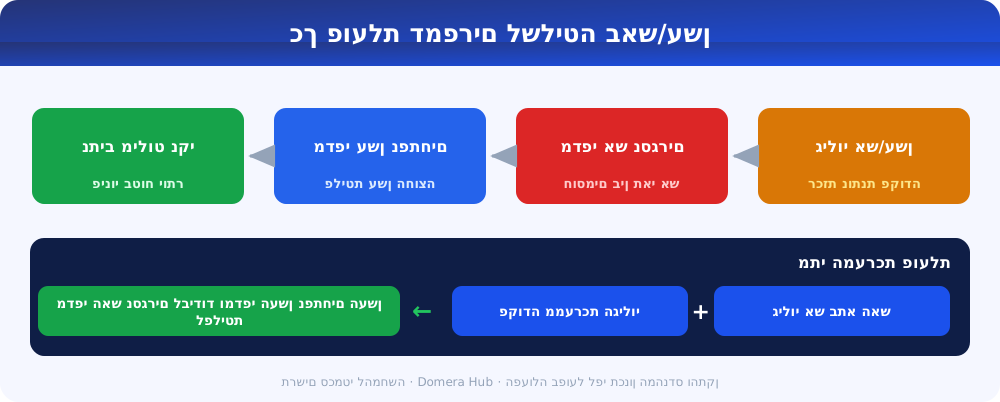
The modern building is divided into fire compartments — areas separated by fire-resistant walls and ceilings designed to stop the spread of fire and smoke and to allow time for evacuation. The problem: the HVAC system's ducts pass through these separating walls, thereby creating a "hole" in the separation. The damper is the flap that closes this hole at the moment of truth.
In practice there are two main types of dampers that fulfill opposite roles:
- Fire Damper — a damper designed to close when fire is detected, in order to block the passage of fire and smoke through the duct from one fire compartment to another. Many of them are held open by a heat-sensitive mechanism (a thermal fuse) that melts at a high temperature and releases the damper to close, or by a motorized actuator that receives a closing command.
- Smoke Damper — a damper operating as part of a smoke control system: it opens or closes on command in order to route smoke — for example, to exhaust smoke from a stairwell or lobby outside, and to keep an escape route free of smoke. These dampers are usually activated automatically by a command from the fire detection system.
The operational flow, in general: the detection system identifies fire or smoke, issues a command, and the fire dampers close to isolate the fire compartment while the smoke dampers and exhaust fans route the smoke out of the escape routes. For this choreography to work, the dampers must be correctly integrated with the HVAC system — stopping the fans, releasing smoke, and ensuring the HVAC itself does not "fight" the smoke control. This is precisely why there are two separate fire certificates here in Israel: one for the dampers themselves, and one for the compliance of the HVAC system from the safety angle.
Why the system is needed + risks of neglect
Smoke, not flames, is the leading cause of harm in building fires: it spreads fast, blocks vision and poisons. A damper that does not close when it should turns the HVAC system into a pipe that spreads smoke and heat from floor to floor and from one fire compartment to another — that is, it cancels out the very separation the building was designed to guarantee. A smoke damper that does not open leaves smoke trapped in the escape route. In both cases the result is the same: a more dangerous evacuation and less time to escape.
The risk of neglect is especially severe because the failure is silent. A damper stuck open due to dust, corrosion, a seized hinge or a faulty actuator looks "fine" in everyday conditions — the building is air-conditioned as usual — and no one notices the problem until it is inspected manually or until the fire itself. Beyond the danger to life, such a failure is also a legal and insurance exposure: inspection of the dampers and certification of the HVAC's fire compliance are a legal requirement, and the absence of a valid certificate may impair insurance coverage and the business license in the event of an incident.
The maintenance regime — what, how often, and how
This component has two separate inspection tracks, both a legal requirement, and both at an annual (every 12 months) frequency:
- Fire/smoke control dampers — annual. A functional inspection of the dampers: that they close or open on command, that the actuators and thermal fuses are sound, that there is no mechanical seizure or corrosion, and that the link to the detection command works. The required document: Fire and Rescue Services Form No. 10 (smoke control system compliance certificate).
- HVAC system compliance certificate (from the fire angle) — annual. A certificate that the HVAC system integrates correctly with fire safety — stopping fans, releasing smoke, and correct behavior of the system in an event. The required document: Fire and Rescue Services Form No. 11 (HVAC system compliance certificate).
Note that this is the safety angle only — this inspection does not replace the routine mechanical maintenance of the HVAC system (filters, belts, cooling), which is an entirely separate matter. The dampers are inspected as part of fire safety; the HVAC itself is maintained as a mechanical system.
Who is authorized to maintain and certify
Both certificates — Form 10 and Form 11 — are signed by a registered engineer. This is an important point that distinguishes this component from most other firefighting systems in the building: a maintenance company holding a standard mark is not enough; a registered engineer is required to certify the soundness of smoke control and the soundness of the HVAC from the safety angle.
In practical terms: the routine maintenance of the dampers (cleaning, lubricating hinges, testing actuators) can be carried out by a maintenance party, but the certificate itself — the document that proves compliance — must be signed by a registered engineer. Do not assume the HVAC technician or the fire company "closes out" the requirement; the one who signs Form 10 and Form 11 is a registered engineer.
Standards and regulation
Inspection of the dampers and certification of the HVAC's fire compliance are a legal (statutory) requirement, applying to every site, and subject to the guidelines of the National Fire and Rescue Authority. The practical expression of the requirement is the Authority's two uniform forms — Form 10 (smoke control) and Form 11 (HVAC) — both signed by a registered engineer each year.
As for a specific Israeli Standard: our requirements matrix contains no dedicated SI explicitly directed at Forms 10 and 11, so we will not cite a precise SI number here — the binding guidance is according to the current standard and the guidelines of the Authority and the manufacturer. The engineering principles of fire compartments, fire dampers and smoke control systems are well known and accepted in the industry; but the specific compliance requirement is defined, as noted, by Form 10, Form 11 and the Authority's guidelines.
Documentation and required forms
Two documents hold up the compliance, and both must be kept and be valid:
- Fire and Rescue Services Form No. 10 — smoke control system (the dampers) compliance certificate. This is the output of the dampers' annual inspection, signed by a registered engineer.
- Fire and Rescue Services Form No. 11 — HVAC system compliance certificate from the fire angle, signed by a registered engineer.
Manage the two forms as two live files, each with its own expiry date. From the point of view of a regulator, an insurer or an investigator in the event of an incident — the two documents together are the proof that the smoke control and HVAC systems are sound. "There is a Form 10 but no Form 11" (or vice versa) is a state of non-compliance, even if something is sitting in a binder.
Common faults and warning signs
- Damper stuck open — dust, corrosion or a seized hinge that prevents closing; the most common silent failure, because the building is air-conditioned as usual and no one notices.
- Faulty thermal fuse / actuator — a fire damper that will not be released to close in heat, or a smoke damper that will not receive an opening command.
- Broken link to the detection command — smoke dampers are activated by the detection system; if the link is disconnected, the dampers will not move in a real event.
- HVAC that keeps operating during an event — fans that do not stop and feed air to the fire or spread smoke, a sign of a failure in the integration with the HVAC (Form 11).
- "Only one certificate" — Form 10 exists but Form 11 has expired, or vice versa; one of the common documentation faults here.
- Blocked access to the dampers — service openings blocked by ceilings or equipment, so that a damper cannot be inspected or released.
The value of professional maintenance management / How Domera helps
The dampers are a clear example of a system that is easy to "forget": it is hidden, it looks sound even when stuck, and it requires two separate certificates from the same professional. Domera's Knowledge Center is designed to help the building manager see exactly these "invisible" components.
In practice, in the Domera system the dampers are managed through a preventive maintenance plan (PPM): for each inspection one open instance exists at any given time, and closing it requires attaching the confirming document (Form 10 or 11 signed by a registered engineer). The system sends reminders before expiry — separately for each of the two forms — and produces compliance reports that show exactly what is valid and what is overdue. The idea is simple: don't rely on memory, but on a system that closes the loop against the document.
Frequently asked questions
What is the difference between a fire damper and a smoke damper?
A fire damper (Fire Damper) is designed to close when fire is detected in order to block the passage of fire and smoke in the duct between fire compartments. A smoke damper (Smoke Damper) is part of a smoke control system — it opens or closes on command in order to route smoke outside and keep an escape route clean. The two fulfill complementary roles in a fire event.
How often are fire/smoke control dampers inspected?
The inspection is carried out once a year (every 12 months), and it is a legal requirement. In parallel, an annual certificate is also required for the compliance of the HVAC system from the fire angle — two separate tracks at an annual frequency.
Who is authorized to certify the dampers and the HVAC compliance?
Both certificates — Form 10 (smoke control) and Form 11 (HVAC) — are signed by a registered engineer. This is a stricter requirement than most firefighting systems in the building, where a maintenance company holding a standard mark is sufficient.
What are Form 10 and Form 11?
Form 10 is a Fire and Rescue Services certificate for the compliance of a smoke control system (the dampers). Form 11 is a Fire and Rescue Services certificate for the compliance of an HVAC system from the safety angle. Both are uniform, annual, and signed by a registered engineer.
Does the fire inspection replace regular HVAC maintenance?
No. The Form 11 certificate examines only the safety angle — that the HVAC integrates correctly with smoke control. The routine mechanical maintenance of the HVAC (filters, belts, cooling) is an entirely separate matter and is not covered by the fire form.
How does a damper receive the command to close or open?
Some fire dampers are held open by a thermal fuse that melts in heat and releases the damper. Smoke dampers and motorized dampers usually receive an automatic command from the fire detection system — and therefore a sound link to the detection system is critical to their operation.
Is there a specific Israeli Standard for the dampers?
The binding guidance is according to the standard and the guidelines of the National Fire and Rescue Authority and the manufacturer, expressed in Forms 10 and 11. Our binding sources contain no dedicated SI number explicitly directed at these forms, so a precise standard number should not be cited but rather reliance placed on the Authority's guidelines.
What happens if a damper is stuck and does not close in a fire?
The stuck damper turns the HVAC duct into a path that spreads fire and smoke between fire compartments and floors — and cancels out the separation the building was designed to guarantee. The result: faster spread, smoke in the escape routes, and heightened danger to life during evacuation.
Further reading
- The PPM guide — how to build a complete preventive maintenance plan for a building.
- Form 10 — smoke control system compliance certificate — the Authority's uniform form for the dampers and smoke control, signed by a registered engineer.
- Form 11 — HVAC system compliance certificate — the certificate of the safety integration between the HVAC and smoke control.
- HVAC system maintenance — the mechanical maintenance of the HVAC, a separate matter from the fire angle.
- Fire and smoke detection system maintenance — the system that issues the activation command to the smoke dampers.
- Knowledge Center — all the guides on building systems in one place.
Frequently asked questions
What is the difference between a fire damper and a smoke damper?
A fire damper (Fire Damper) is designed to close when fire is detected in order to block the passage of fire and smoke in the duct between fire compartments. A smoke damper (Smoke Damper) is part of a smoke control system — it opens or closes on command in order to route smoke outside and keep an escape route clean. The two fulfill complementary roles in a fire event.
How often are fire/smoke control dampers inspected?
The inspection is carried out once a year (every 12 months), and it is a legal requirement. In parallel, an annual certificate is also required for the compliance of the HVAC system from the fire angle — two separate tracks at an annual frequency.
Who is authorized to certify the dampers and the HVAC compliance?
Both certificates — Form 10 (smoke control) and Form 11 (HVAC) — are signed by a registered engineer. This is a stricter requirement than most firefighting systems in the building, where a maintenance company holding a standard mark is sufficient.
What are Form 10 and Form 11?
Form 10 is a Fire and Rescue Services certificate for the compliance of a smoke control system (the dampers). Form 11 is a Fire and Rescue Services certificate for the compliance of an HVAC system from the safety angle. Both are uniform, annual, and signed by a registered engineer.
Does the fire inspection replace regular HVAC maintenance?
No. The Form 11 certificate examines only the safety angle — that the HVAC integrates correctly with smoke control. The routine mechanical maintenance of the HVAC (filters, belts, cooling) is an entirely separate matter and is not covered by the fire form.
How does a damper receive the command to close or open?
Some fire dampers are held open by a thermal fuse that melts in heat and releases the damper. Smoke dampers and motorized dampers usually receive an automatic command from the fire detection system — and therefore a sound link to the detection system is critical to their operation.
Is there a specific Israeli Standard for the dampers?
The binding guidance is according to the standard and the guidelines of the National Fire and Rescue Authority and the manufacturer, expressed in Forms 10 and 11. Our binding sources contain no dedicated SI number explicitly directed at these forms, so a precise standard number should not be cited but rather reliance placed on the Authority's guidelines.
What happens if a damper is stuck and does not close in a fire?
The stuck damper turns the HVAC duct into a path that spreads fire and smoke between fire compartments and floors — and cancels out the separation the building was designed to guarantee. The result: faster spread, smoke in the escape routes, and heightened danger to life during evacuation.