
In this article
- How the system works
- Why the system is needed + risks of neglect
- The maintenance regime — what, how often, and how
- Who is authorized to maintain and certify
- Standards and regulation
- Documentation and required forms
- Common faults and warning signs
- The value of professional maintenance management / How Domera helps
- Frequently asked questions
- Further reading
- Frequently asked questions
Fire Water Reservoir and Water Network Characterization — The Reserve That Powers the Entire Firefighting Network
A fire water reservoir is the dedicated water reserve that ensures a volume of water is available for firefighting at any given moment — even when the municipal water supply weakens or is cut off during a fire. "Water network characterization" is the engineering test that proves the firefighting network actually has the flow and pressure required to deliver water to its target — that is, that the reservoir and piping will meet the requirement at the moment of truth and not just on paper.
For a building manager or maintenance engineer, the reservoir and the network characterization are the infrastructure the rest of the firefighting system rests upon: the fire pump, the sprinklers and the hose reels all draw from the reservoir and depend on the network having enough water at the correct pressure. A neglected reservoir — silted, contaminated or lacking volume — and a network whose performance no one has characterized, may effectively neutralize the entire firefighting chain even if all the other components are sound. In this article we explain how the system works, why it is needed, the maintenance regime in Israel, who is authorized to inspect and certify, and how to manage all of this without relying on memory.
Part of a bigger picture: the reservoir and the network characterization are one component within a complete preventive maintenance plan. For the full framework — all the systems, frequencies, authorized parties and forms — see the complete PPM guide.
How the system works
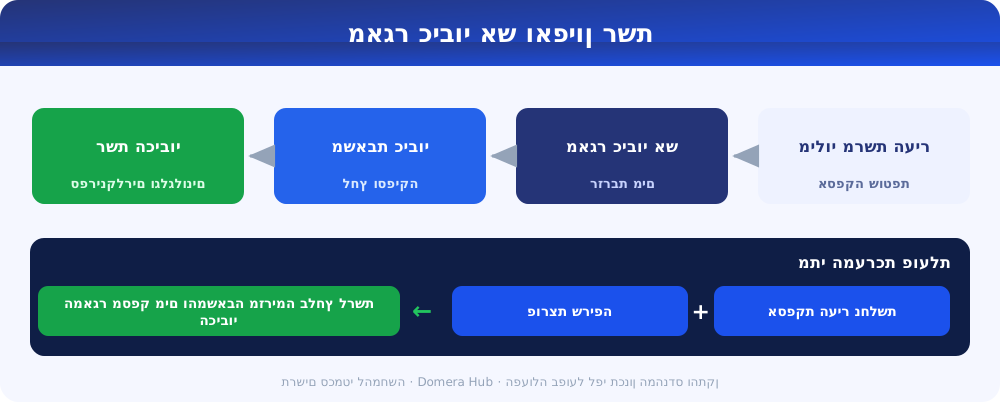
The system is built from two parts that complement each other: the reservoir itself — a physical component, and water network characterization — a performance test. The reservoir is a dedicated storage tank (above-ground or underground) holding a volume of water reserved for firefighting only. It is continuously filled from the municipal water network, but its main role is to keep an available reserve: if a fire breaks out and the city supply is insufficient — or is compromised — the reservoir provides the water until the incident is over.
From the reservoir, the water is drawn by the fire pump, which raises it to the required pressure and flow and delivers it to the firefighting network — to the sprinklers and to the hose reels and firefighting stations. That is: the reservoir is the source, the pump is the driving force, and the network is the conveyance pipe. If any one of the links lacks enough water or pressure — the entire chain fails.
And here water network characterization comes in. It is not enough that the reservoir is full; it must be proven that the entire network is capable of delivering the flow (quantity of water per unit of time) and pressure required at every point. Network characterization is a measured test of the network's performance — opening points, measuring actual pressure and flow — that documents an engineering "identity certificate" of the network. The characterization document is what makes it possible to design, inspect and verify that the reservoir, the pump and the piping do indeed meet the firefighting design requirements.
Why the system is needed + risks of neglect
The need for a reservoir stems from a simple gap: the municipal water supply is intended for routine use and is not guaranteed at the intensity required during a fire — it may weaken, be compromised, or simply fail to supply enough water for prolonged extinguishing at several points simultaneously. The reservoir closes this gap by keeping a dedicated, available and immediate volume of water.
The risk of neglect splits into two planes. On the reservoir plane: over the years, sediment, sludge, rust from the walls and sometimes biological growth accumulate at the bottom of the reservoir. These reduce the actually available volume, may clog filters and impair pumping, and in severe cases contaminate the water to the point of damaging the firefighting equipment. A reservoir that looks "full" may in fact hold less clean water than the design requires. On the network characterization plane: without measurement, no one knows whether the network still provides the flow and pressure — changes in the piping, blockages, partially closed valves or wear can lower performance gradually and with no external sign.
Alongside the safety risk there is a legal and insurance aspect. Water network characterization is a legal (statutory) requirement, and the absence of a valid characterization document may be considered non-compliance with the National Fire and Rescue Authority. In the event of an incident, the absence of proper documentation — whether of the network characterization or of the reservoir cleaning — may also impair insurance coverage, since the insurer expects proof that the infrastructure was maintained as required.
The maintenance regime — what, how often, and how
The system has two separate periodic tracks, both on a once-every-five-years cycle but with different parties:
- Fire water reservoir interior inspection and cleaning — once every five years (every 60 months). The action is carried out by a licensed maintenance company holding a standard mark, and includes emptying or accessing the reservoir interior, cleaning sediment and rust, inspecting the integrity of the walls and filters, and verifying that the available volume is correct. The document to keep: a reservoir interior inspection and cleaning certificate. In our requirements matrix this action is marked as a recommended practice (not as a formal legal requirement) — yet it is essential to the actual availability of the water and to the soundness of the system.
- Water network characterization — once every five years (every 60 months). The test is carried out by a laboratory accredited for this field, and includes measuring actual flow and pressure at the network points and producing an engineering "identity certificate" of the network's performance. The document to keep: a water network characterization document from an accredited laboratory. This action is a legal (statutory) requirement, applying to every site.
Note the distinction: cleaning the reservoir is a physical maintenance action (maintenance company), and network characterization is a measured performance test (accredited laboratory). Both are on a five-year cycle, but they are two independent tracks with two documents from two different parties — do not assume that one covers the other. Beyond these two tracks, routine maintenance of the reservoir and network should be carried out according to the standard's and the manufacturer's guidance, without relying on the official five-year cycle alone.
Who is authorized to maintain and certify
Authorizations are divided by the type of action:
- Reservoir interior inspection and cleaning — carried out solely by a licensed maintenance company holding a standard mark for the field of fire suppression systems. Such a company is familiar with the standard's requirements and the guidelines of the National Fire and Rescue Authority, and it is the one that issues the inspection and cleaning certificate.
- Water network characterization — carried out by a laboratory accredited for this field (a laboratory accredited by the Israel Laboratory Accreditation Authority), which issues the network characterization document. This is a measurement discipline separate from reservoir maintenance.
The practical point: for a building with a fire reservoir, one certificate is usually not enough. Both the inspection-and-cleaning certificate from the maintenance company and the network characterization document from the laboratory are required — two documents from two different accredited parties, on two tracks.
Standards and regulation
Water network characterization is a legal (statutory) requirement applying to every site; reservoir interior inspection and cleaning is marked in the matrix as a recommended practice, but both are subject to the standard and the guidelines of the National Fire and Rescue Authority and the manufacturer. It is important to be precise: our requirements matrix contains no dedicated SI number or fire form number explicitly directed at the fire water reservoir or the network characterization — so we will not cite a specific "SI" for this system here, but instead refer generally to the standard and the guidelines of the Authority and the manufacturer.
The closest standards context is the system the reservoir and network feed — the automatic sprinkler system, whose compliance certificate is Fire Form 7 under SI 1596. Since the reservoir and the network characterization are an inseparable part of the water supply array for the sprinklers, their performance is examined as part of the overall compliance of the firefighting network — but the network characterization document and the reservoir cleaning certificate are the direct documents attesting to the soundness of this system.
Documentation and required forms
The documents that hold up the system's compliance:
- Reservoir interior inspection and cleaning certificate — the output of the reservoir's five-year inspection and cleaning, from the maintenance company.
- Water network characterization document from an accredited laboratory — the output of the five-year network characterization; the engineering "identity certificate" of the network's performance.
The reservoir and the network characterization have no uniform dedicated fire form in the matrix — but since they feed the sprinklers, it is worth managing their documentation together with sprinkler system maintenance and its compliance certificate (Form 7, SI 1596), which is the closest regulatory context in the firefighting array. Manage each document as a live file with an expiry date, so that at any moment it is clear what is valid and when it must be renewed.
Common faults and warning signs
- Accumulation of sediment and sludge at the bottom of the reservoir — reduces the actually available volume and clogs filters; a reservoir that looks full holds less clean water than the design requires.
- Rust or corrosion in the reservoir walls — impairs the tank's integrity, contaminates the water and in severe cases risks leakage.
- Water level lower than required — a sign of a filling fault, a leak or a faulty fill valve; reduces the reserve available for firefighting.
- Drop in flow or pressure in the network characterization — evidence of a blockage, a partially closed valve or piping wear; revealed only by measurement, not by eye.
- Expired network characterization document — means there is no current proof that the network meets the requirements; a direct legal and insurance exposure.
- Biological growth or odor in the water — a sign of neglected cleaning; requires reservoir interior inspection and cleaning before the contamination damages the equipment.
The value of professional maintenance management / How Domera helps
The reservoir and the network characterization are a clear example of infrastructure that is easy to forget: the cycle is long (five years), there are two tracks from two different parties, and a fault in them is invisible until the moment of truth — exactly when the entire firefighting network depends on them. Missing one of the tracks leaves the system exposed for years. Domera's Knowledge Center is designed to help the building manager see this picture clearly.
In practice, in the Domera system the reservoir and the network characterization are managed through a preventive maintenance plan (PPM): for each inspection one open instance exists at any given time, and closing it requires attaching the confirming document (the cleaning certificate from the maintenance company, and the characterization document from the laboratory). The system sends reminders before expiry — separately for each track, even when it is a five-year cycle that is easy to lose track of — and produces compliance reports that show exactly what is valid and what is overdue. The idea is simple: don't rely on the fact that "the reservoir was cleaned once", but on a system that closes the loop against the document.
Frequently asked questions
What is a fire water reservoir and why is it needed?
A fire water reservoir is a storage tank holding a dedicated water reserve for firefighting only. It is needed because the municipal water supply is not guaranteed at the intensity required during a fire — it may weaken or be compromised — and the reservoir ensures an available and immediate volume of water until the incident is over.
What is water network characterization?
Water network characterization is a measured test of the firefighting network's performance — opening points and measuring actual flow and pressure — that produces an engineering identity certificate of the network. It proves that the reservoir, the pump and the piping are indeed capable of supplying the water at the required pressure and quantity at every point.
How often is the reservoir inspected and cleaned?
Reservoir interior inspection and cleaning are carried out once every five years (every 60 months) by a licensed maintenance company holding a standard mark. In the requirements matrix this action is marked as a recommended practice, but it is essential to the availability of the water and to the soundness of the system.
How often is water network characterization performed?
Water network characterization is performed once every five years (every 60 months) by a laboratory accredited for this field, and it is a legal (statutory) requirement applying to every site. The document to keep is a water network characterization document from the laboratory.
Who is authorized to inspect and certify?
Reservoir interior inspection and cleaning is carried out and certified by a licensed maintenance company holding a standard mark. Water network characterization is carried out by a laboratory accredited for this field, which issues the characterization document. These are two different accredited parties on two tracks.
What is the relationship between the reservoir, the pump and the sprinklers?
The reservoir is the water source, the fire pump raises it to the required pressure and flow, and the piping network conveys it to the sprinklers and the hose reels. If any one of the links lacks enough water or pressure — the entire firefighting chain fails, even if the other components are sound.
What happens if the reservoir or the network characterization is neglected?
A neglected reservoir accumulates sediment and rust that reduce the available volume and contaminate the water, and a network that has not been characterized may lose flow and pressure with no external sign. This is accompanied by a risk of non-compliance with the National Fire and Rescue Authority and possible impairment of insurance coverage in the event of an incident.
How does Domera help manage this?
Through a preventive maintenance plan (PPM): one open instance per inspection, closing against the confirming document, separate reminders before expiry for each track — especially critical on a five-year cycle that is easy to lose track of — and compliance reports that show exactly what is valid and what is overdue.
Further reading
- The PPM guide — how to build a complete preventive maintenance plan for a building.
- Sprinkler and fire suppression system maintenance — the system the reservoir and pump feed, inspection and maintenance.
- Extinguishers, hose reels and firefighting stations — the firefighting equipment that also depends on water from the reservoir.
- Water systems, backflow prevention and Legionella — water quality and the separation of firefighting water from drinking water in the building network.
- Knowledge Center — all the guides on building systems in one place.
Frequently asked questions
What is a fire water reservoir and why is it needed?
A fire water reservoir is a storage tank holding a dedicated water reserve for firefighting only. It is needed because the municipal water supply is not guaranteed at the intensity required during a fire — it may weaken or be compromised — and the reservoir ensures an available and immediate volume of water until the incident is over.
What is water network characterization?
Water network characterization is a measured test of the firefighting network's performance — opening points and measuring actual flow and pressure — that produces an engineering identity certificate of the network. It proves that the reservoir, the pump and the piping are indeed capable of supplying the water at the required pressure and quantity at every point.
How often is the reservoir inspected and cleaned?
Reservoir interior inspection and cleaning are carried out once every five years (every 60 months) by a licensed maintenance company holding a standard mark. In the requirements matrix this action is marked as a recommended practice, but it is essential to the availability of the water and to the soundness of the system.
How often is water network characterization performed?
Water network characterization is performed once every five years (every 60 months) by a laboratory accredited for this field, and it is a legal (statutory) requirement applying to every site. The document to keep is a water network characterization document from the laboratory.
Who is authorized to inspect and certify?
Reservoir interior inspection and cleaning is carried out and certified by a licensed maintenance company holding a standard mark. Water network characterization is carried out by a laboratory accredited for this field, which issues the characterization document. These are two different accredited parties on two tracks.
What is the relationship between the reservoir, the pump and the sprinklers?
The reservoir is the water source, the fire pump raises it to the required pressure and flow, and the piping network conveys it to the sprinklers and the hose reels. If any one of the links lacks enough water or pressure — the entire firefighting chain fails, even if the other components are sound.
What happens if the reservoir or the network characterization is neglected?
A neglected reservoir accumulates sediment and rust that reduce the available volume and contaminate the water, and a network that has not been characterized may lose flow and pressure with no external sign. This is accompanied by a risk of non-compliance with the National Fire and Rescue Authority and possible impairment of insurance coverage in the event of an incident.
How does Domera help manage this?
Through a preventive maintenance plan (PPM): one open instance per inspection, closing against the confirming document, separate reminders before expiry for each track — especially critical on a five-year cycle that is easy to lose track of — and compliance reports that show exactly what is valid and what is overdue.