
In this article
- How the system works
- Why the system is needed + risks of neglect
- The maintenance regime — what, how often, and how
- Who is authorized to maintain and certify
- Standards and regulation
- Documentation and forms
- Common faults and warning signs
- The value of professional maintenance management / How Domera helps
- Frequently asked questions
- Further reading
- Frequently asked questions
Fixed Ladders in the Building — Mechanism, Safety and Engineer Certification
A fixed ladder is a ladder permanently fixed to a structure and serving as a dedicated means of access — usually for climbing to a roof, a machine room, a technical shaft or a level with no stairway access. Although it appears to be the simplest component in the building, a fixed ladder is in fact a work-at-height safety device: using it means climbing at height, and its failure — detachment from the wall, a corroded rung or a damaged protective cage — may cause a fatal fall. In Israel, the soundness of the fixed ladders at a site requires a registered civil engineer's certificate documenting all the ladders and their location — a legal requirement, not a recommendation. This article explains how a fixed ladder is built and works, why its maintenance is critical, who is authorized to certify it, and what documentation must be kept.
For a building manager or maintenance officer, the fixed ladder is a classic example of a "transparent" component that tends to be forgotten — until a maintenance worker climbed it to the roof, leaned on a corroded rung, and fell. Precisely because it is so routine, it is easy to miss the fact that it sits at the core of the site's work-at-height safety.
The fixed ladder is one component within a complete preventive maintenance plan for the building. For the full framework — all the systems, frequencies, authorized parties and required documents — see the complete PPM guide.
How the system works
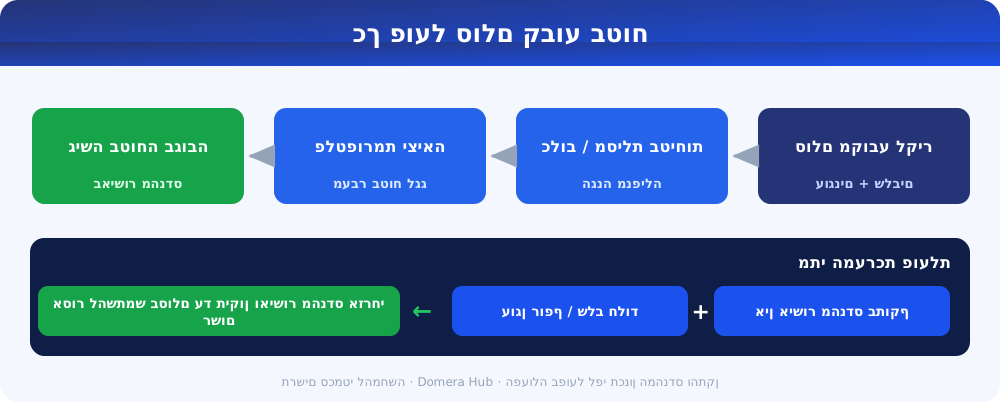
A fixed ladder is not a portable ladder someone leaned against a wall, but a permanently fixed structure whose every component is designed to bear a person in a vertical climb. Its main components:
- The ladder rungs and rails (Rails) — two vertical rails and horizontal rungs between them, fixed to the wall or structure by wall anchors at fixed intervals. The material (galvanized steel, aluminum or stainless steel) and the spacing are derived from the design requirements and the environment (exposure to rain, vapor, corrosion).
- The wall fixings (Fixings) — the bolts and supports that hold the ladder against the structure. These are the most silent point of failure: corrosion or loosening of an anchor, especially in an outdoor environment, gradually detaches the ladder from the wall.
- Fall protection means — on ladders above a certain height, a protective cage (back guard) surrounding the climber is usually required, or alternatively a vertical safety rail / life cable to which the climber connects with a harness and a fall arrester. The choice between the two and the height at which they are required are determined according to the standard and the engineer's guidance.
- Exit platform / upper walkway — at the top end, a walkway or railing that allows safe dismounting from the ladder onto the roof or level, without climbing "over" the edge.
The usage flow is simple but safety-oriented: the climber enters the base of the ladder, connects if necessary to the safety rail or enters the cage, and climbs vertically in three points of contact up to the exit platform. Throughout, the load passes from the rungs through the rails to the wall anchors and to the structure — and therefore every link in the chain must be sound. It is important to distinguish: the cage or rail protects the climber during the ascent, but on the roof itself an additional protective layer is usually required — life lines and anchor points — to which one connects when working on the surface.
Why the system is needed + risks of neglect
Fixed ladders are, in many buildings, the only way to reach infrastructure that requires routine maintenance: HVAC on the roof, pumps, water reservoirs, firefighting systems, antennas and panels. Without them, every maintenance visit to the roof becomes a dangerous improvisation. But precisely because they are used again and again, wear that accumulates silently turns them into a trap.
What happens when a fixed ladder is not inspected and not maintained:
- Fall from height — the severe and direct risk. A rung that breaks under the weight, a wall anchor that has detached, a deformed protective cage that has lost its function, or a slippery surface on the rungs — each of these may cause the climber to fall. A fall from height is one of the most common causes of death in construction and maintenance work.
- Legal liability of the building occupier — installing an unsound access ladder, or the absence of a valid engineer's certificate, is a breach of the building occupier's safety obligations. In an accident, the exposure of the occupier and the work supervisor is great.
- Insurance exposure — a fall incident from a ladder that did not meet the documentation and inspection requirements may impair insurance coverage and leave the occupier exposed.
- Maintenance paralysis — when a ladder is identified as unsafe, it may not be used — and therefore access to everything it serves (HVAC, pumps, roof systems) is blocked until it is repaired.
The maintenance regime — what, how often, and how
According to the mandatory maintenance matrix, the compliance certification of the fixed ladders at a site is not on a fixed periodic cycle but rather one-time / as needed: a registered civil engineer's certificate documenting all the ladders and their location is required — for example upon installation, upon a change or addition of a ladder, after a substantial repair, or when doubt arises about soundness. This is a legal (statutory) requirement applying to every site where fixed ladders exist.
The fact that there is no fixed periodic frequency in the matrix does not mean "inspect once and forget". Between the engineer's certificates, a fixed ladder requires routine visual monitoring by the maintenance team: periodic inspection of the condition of the rungs, the anchors, the cage or rail, and signs of corrosion — and a visual inspection before every climb. Do not assume a periodic frequency that does not appear in the binding source; the visual inspection regime is determined by site policy and by the guidance of the standard and the engineer. Any defect discovered — a deformed rung, a loose anchor, a damaged cage — requires taking the ladder out of service until repaired, and sometimes a renewed engineer's certificate.
Who is authorized to maintain and certify
The compliance certificate of the fixed ladders is issued solely by a registered civil engineer — the only party authorized, under the binding source, to determine that the ladders are installed and sound and to document them. The certificate is not merely "paper": it includes a register of all the ladders and their location at the site, so that there is a full mapping of the work-at-height access means.
Alongside the engineer, the routine maintenance and visual inspection are the responsibility of the building's maintenance team: cleaning, detecting corrosion, checking anchors and replacing damaged components. But the official soundness determination — the one that holds up legal compliance — belongs to the registered civil engineer alone. It is important to be precise: inspection of the ladder itself does not automatically cover the life lines and anchor points on the roof, which are inspected on a separate track by their own authorized party.
Standards and regulation
Certification of the fixed ladders is a statutory requirement. The regulatory basis for work-at-height safety and access means in Israel is derived from the Work Safety Ordinance and its regulations, including the work-at-height regulations, under which safe access to elevated workplaces and documentation of their soundness are required.
As for a specific SI number for fixed ladders — our requirements matrix contains no dedicated standard number or fire form for this system, so we do not cite an SI number or clause here. The design requirements (the height from which a cage or rail is required, rung spacing, the type of anchors), the certification criteria and the inspection intervals are determined according to the current standard and the guidance of the Authority/manufacturer and according to the judgment of the registered civil engineer. The engineer's certificate is the binding document.
Documentation and forms
The document that holds up the system's compliance is the registered civil engineer's certificate, including a register of all the fixed ladders and their location at the site. Keep it as a live and accessible file — this is the documentation that proves, before a regulator or an investigator after an incident, that the work-at-height access means were mapped and certified as sound. Update it upon every installation, removal or change of a ladder.
It is also recommended to keep the visual inspection log of the maintenance team, documentation of repairs and component replacements, and the workers' work-at-height training certificates. Fixed ladders have no dedicated fire form — the engineer's certificate and the accompanying register are the core of the documentation required for legal compliance.
Common faults and warning signs
- Corrosion in the rungs and rails — rust, especially in outdoor ladders exposed to rain and vapor, that weakens the cross-section to the point of breakage. A rung with deep rust or pitting — stop use until inspected.
- Loose or corroding wall anchors — the silent failure: a loosened bolt or cracked concrete around the anchor. A ladder that moves relative to the wall when touched — an immediate danger.
- Damaged or missing protective cage — a deformed cage, missing or corroded links that have lost their protective ability, or a high ladder with no cage/rail at all.
- Slippery surface on the rungs — smooth rungs, covered in moss, ice, oil or peeling paint — a risk of a foot slipping during the climb.
- Deficient exit platform — an upper walkway with no railing, or an unsafe transition from the ladder to the roof requiring climbing "over" the edge.
- Use without suitable protection — climbing a high ladder without connecting to a safety rail (where one exists), or without a prior visual inspection.
The value of professional maintenance management / How Domera helps
The fixed ladder well illustrates the gap between "looks sound" and "documented and certified": a routine component that is easy to forget, yet the absence of a valid engineer's certificate poses a legal problem and a real danger to life. Domera's Knowledge Center is designed to help the maintenance manager remember exactly these "transparent" items — before they turn into an accident or a violation.
In practice, in Domera the ladder certification is also managed through a preventive maintenance plan (PPM): when an inspection or renewed certification is required (installation, change, defect), one open instance is opened at any given time, and closing it requires attaching the registered civil engineer's certificate for the ladders. The system keeps the register and location as a live document, sends reminders when a defined inspection date approaches, and produces compliance reports. The idea is simple: close the loop against the confirming document, so that an access ladder without a valid certificate is not left in use through oversight.
Frequently asked questions
What is a fixed ladder and how does it differ from a portable ladder?
A fixed ladder is permanently fixed to a structure and serves as a dedicated means of access — to a roof, a machine room or a technical shaft. Unlike a portable ladder that is moved and stored, the fixed ladder is part of the building infrastructure, and therefore its soundness requires documentation and an engineer's certificate.
How often does a fixed ladder need to be inspected?
The requirements matrix has no fixed periodic frequency — the certificate is one-time / as needed: upon installation, upon a change, after a substantial repair or when doubt arises about soundness. However, between the certificates a routine visual inspection by the maintenance team and before every climb is required.
Who is authorized to certify the soundness of the ladders?
A registered civil engineer — he is the only party, under the binding source, that issues the compliance certificate, which includes a register of all the ladders and their location at the site. The routine visual maintenance is the responsibility of the maintenance team, but the official soundness determination belongs to the engineer.
Is it permitted to use a fixed ladder without an engineer's certificate?
The engineer's certificate is a legal requirement. Using an access ladder that is not certified or not sound is a breach of the building occupier's safety obligations, endangers human life and may impair insurance coverage and lead to legal liability.
When must a fixed ladder have a protective cage or safety rail?
Above a certain height, fall protection is usually required — a protective cage surrounding the climber, or a vertical safety rail / life cable to which one connects with a harness. The exact height and the type of protection are determined according to the standard and the engineer's guidance; we do not specify a particular number here.
What is the difference between the ladder and the life lines on the roof?
They are complementary systems but inspected separately: the ladder and its protection means enable safe climbing to the roof and are certified by a civil engineer, while the life lines and anchor points on the roof protect the worker during work on the surface and are inspected on a separate track. Both must be sound.
Is there a fire form or dedicated SI for fixed ladders?
Not in our requirements matrix — there is no fire form and no dedicated SI number directed at fixed ladders. The binding document is the registered civil engineer's certificate; the design and inspection requirements are determined according to the current standard and the guidance of the Authority/manufacturer and by virtue of the Work Safety Ordinance.
Further reading
- The complete PPM guide — how to build a complete preventive maintenance plan for a building, including engineer inspections and work-at-height access means.
- Life lines and anchor points — the fall arrest array on the roof, complementing the ladder and protecting the worker during work on the surface.
- The building occupier's safety obligations — the legal framework for work-at-height safety, including the access means and their documentation.
- Knowledge Center — all the guides on building systems in one place.
Frequently asked questions
What is a fixed ladder and how does it differ from a portable ladder?
A fixed ladder is permanently fixed to a structure and serves as a dedicated means of access — to a roof, a machine room or a technical shaft. Unlike a portable ladder that is moved and stored, the fixed ladder is part of the building infrastructure, and therefore its soundness requires documentation and an engineer's certificate.
How often does a fixed ladder need to be inspected?
The requirements matrix has no fixed periodic frequency — the certificate is one-time / as needed: upon installation, upon a change, after a substantial repair or when doubt arises about soundness. However, between the certificates a routine visual inspection by the maintenance team and before every climb is required.
Who is authorized to certify the soundness of the ladders?
A registered civil engineer — he is the only party, under the binding source, that issues the compliance certificate, which includes a register of all the ladders and their location at the site. The routine visual maintenance is the responsibility of the maintenance team, but the official soundness determination belongs to the engineer.
Is it permitted to use a fixed ladder without an engineer's certificate?
The engineer's certificate is a legal requirement. Using an access ladder that is not certified or not sound is a breach of the building occupier's safety obligations, endangers human life and may impair insurance coverage and lead to legal liability.
When must a fixed ladder have a protective cage or safety rail?
Above a certain height, fall protection is usually required — a protective cage surrounding the climber, or a vertical safety rail / life cable to which one connects with a harness. The exact height and the type of protection are determined according to the standard and the engineer's guidance; we do not specify a particular number here.
What is the difference between the ladder and the life lines on the roof?
They are complementary systems but inspected separately: the ladder and its protection means enable safe climbing to the roof and are certified by a civil engineer, while the life lines and anchor points on the roof protect the worker during work on the surface and are inspected on a separate track. Both must be sound.
Is there a fire form or dedicated SI for fixed ladders?
Not in our requirements matrix — there is no fire form and no dedicated SI number directed at fixed ladders. The binding document is the registered civil engineer's certificate; the design and inspection requirements are determined according to the current standard and the guidance of the Authority/manufacturer and by virtue of the Work Safety Ordinance.