In this article
- How the System Works
- Why the System Is Needed + Risks of Neglect
- The Maintenance Regime — What, How Often, and How
- Who Is Licensed to Maintain and Certify
- Standards and Regulation
- Required Documentation and Forms
- Common Faults and Warning Signs
- The Value of Professional Maintenance Management / How Domera Helps
- Frequently Asked Questions
- Further Reading
- Frequently asked questions
An LPG installation (liquefied petroleum gas, LPG) is the system of piping, regulators and devices that carries cooking or heating gas from the storage vessel in the building to the end consumers — kitchens, boilers, heating and combustion systems. Because this is a flammable and explosive gas operating under pressure, the law in Israel requires a periodic inspection by a certified LPG installer per SI 158 Part 4 — an annual inspection (form D5) and a comprehensive inspection every five years (form D4) — as a safety condition and a compliance condition.
The LPG installation is only one of the inspection cycles a building manager must track. The full order — what is inspected, how often, who signs and which document is kept — is consolidated in the complete PPM guide.
How the System Works
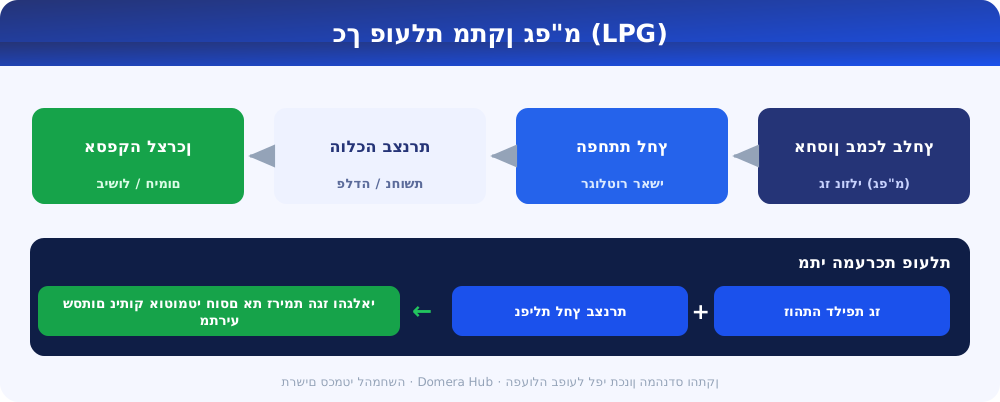
An LPG installation begins at the storage vessel (LPG reservoir) where the gas is stored in a liquid state under pressure. From the vessel the gas exits through a primary pressure regulator that reduces the high pressure in the vessel to a safe working pressure, and continues through the supply piping — usually steel or copper — into the building. Along the line, second-stage regulators, shut-off valves and emergency taps are installed, allowing a zone or a single consumer to be isolated.
Near the end consumers, safety means are installed: an automatic shut-off valve that blocks the gas flow in the event of a leak or a pressure drop, gas detectors that alert to a gas concentration in the air, and ventilation of the rooms in which the vessel and the piping are installed. The chain of operation is therefore: storage in the vessel under pressure → pressure reduction at the regulator → conveyance in the piping → controlled supply to the consumer, with each stage backed by isolation means and leak detection.
Why the System Is Needed + Risks of Neglect
An LPG installation supplies the cooking and heating energy in many buildings — institutional kitchens, restaurants, water-heating boilers and combustion systems. Without a sound installation, essential services come to a halt; but beyond that, a neglected gas installation is one of the most severe risks in a building.
LPG is heavier than air and tends to accumulate in low spots and enclosed spaces; an undetected leak can lead to ignition and a destructive explosion. Corrosion in the piping, wear in a regulator, a defective seal or a shut-off valve that does not operate — all of these turn a small fault into a fatal event. Neglect also entails legal and insurance exposure: operating a gas installation without a valid inspection per the standard impairs safety, may void insurance coverage in the event of an incident, and expose the building manager and the building owner to personal liability. The risk here connects to the building's overall fire safety — as with the suppression and detection systems — since a gas source is a potential fire source.
The Maintenance Regime — What, How Often, and How
The inspection regime of an LPG installation derives directly from SI 158 Part 4, and is documented in the dedicated inspection form in each cycle:
- Annual inspection — form D5: once every 12 months, by an LPG installer, per SI 158 Part 4 — form D5. A statutory inspection of the installation's soundness: the tightness of the piping, the soundness of the regulators, the shut-off valves and the connections.
- Comprehensive inspection — form D4: once every five years (60 months), by an LPG installer, per SI 158 Part 4 — form D4. A more thorough and in-depth inspection of the integrity of the entire installation.
- The storage vessel (LPG reservoir): inspected in a separate cycle — see the article LPG reservoir / vessel — as a pressure vessel standing on its own.
Alongside the statutory inspections it is recommended to perform ongoing visual checks: detecting a gas smell, checking the ventilation of the rooms, keeping the emergency taps accessible, and the soundness of the gas detectors. These checks do not replace the LPG-installer inspection but complement it between cycles. Any frequency or requirement not explicitly stated in SI 158 Part 4 — should be determined per the current standard and the authority and manufacturer guidance.
Who Is Licensed to Maintain and Certify
The certification here is unequivocal: the periodic inspection of the LPG installation and the issuance of forms D4/D5 may be performed only by a suitably certified LPG installer. One must not rely on a general technician, a plumber or a maintenance worker for certifying the installation — the statutory inspection is reserved for a certified LPG installer alone.
The building's maintenance worker may (and is required to) perform ongoing visual checks — smell, ventilation, tap accessibility — but these do not replace the certified installer's inspection and do not constitute a certification. Coordinating a certified LPG installer in advance, before the previous inspection expires, is the building manager's responsibility.
Standards and Regulation
The periodic inspection of an LPG installation is subject to SI 158 Part 4, which defines the safety requirements for liquefied petroleum gas installations and the inspection regime: form D5 for the annual inspection and form D4 for the inspection every five years, both by an LPG installer. These are statutory requirements applying to every site where an LPG installation is installed.
Beyond the standard's inspection, the gas installation also falls within the building's fire-safety domain before the National Fire and Rescue Authority, within the framework of the uniform gas annex — a document that consolidates the details of the gas installation for licensing and fire-safety purposes. One must not rely on an SI number, clause or frequency not explicitly stated in SI 158 Part 4 or in the authority's guidance — any detail not anchored there should be clarified against the current standard and the authority and manufacturer guidance.
Required Documentation and Forms
The binding documents for an LPG installation are form D5 (the annual inspection) and form D4 (the inspection every five years) per SI 158 Part 4, signed by the LPG installer. They should be kept accessible in the building file, verified to be valid, and their expiry dates tracked in order to coordinate a re-inspection in advance.
Alongside forms D4/D5, a uniform gas annex is usually also required within the framework of the fire-service requirements — see the explanatory article on the uniform gas annex (form 18) and the official PDF attached to it. The combination of the two sets of documentation — the standard's inspection and the uniform annex — is what attests to a lawful and safe gas installation.
Common Faults and Warning Signs
- A gas smell (the odorant added to LPG) near the vessel, the piping or the end consumers — an immediate warning sign requiring shut-off, ventilation and an installer inspection.
- Corrosion, staining or mechanical damage in the piping and connections — potential leak points.
- A pressure regulator that does not stabilize the pressure — an unstable flame or a drop in flow at the consumer.
- An automatic shut-off valve that does not close during a test — a failure in the central safety means.
- Blocked ventilation in the vessel room or the consumer rooms — a danger of gas accumulation.
- A gas detector that does not respond or is disconnected — nullifying the early-detection layer.
- An expired form D4/D5 — requires coordinating a re-inspection without delay.
The Value of Professional Maintenance Management / How Domera Helps
A gas installation does not tolerate "forgot to coordinate an inspection." Domera manages the LPG installation in a PPM program: a single open instance per inspection plan, closure only against a certifying document (a signed form D4/D5), an automatic reminder before the expiry of each inspection, and a compliance report that shows at any moment which inspections are valid and which are approaching expiry. In this way the building manager knows that the gas installation is safe and lawful to operate — without relying on memory, and without being caught with an expired form.
Frequently Asked Questions
How often is an LPG installation inspected?
Per SI 158 Part 4, an annual inspection (form D5) is required once every 12 months, and a comprehensive inspection (form D4) once every five years. Both inspections are performed by a certified LPG installer.
Who is licensed to inspect and certify an LPG installation?
Only a suitably certified LPG installer may perform the periodic inspection and issue forms D4/D5. A general technician or a maintenance worker is not authorized to certify the installation.
What is the difference between form D4 and form D5?
Form D5 is the annual inspection (every 12 months), and form D4 is the more comprehensive inspection every five years. Both forms are per SI 158 Part 4 and by an LPG installer.
What is the uniform gas annex?
The uniform gas annex is a document that consolidates the details of the gas installation for licensing and fire-safety purposes before the National Fire and Rescue Authority. See the form 18 (uniform gas annex) article for details and the link to the official PDF.
What is the difference between an LPG installation and an LPG reservoir?
The LPG installation is the piping, regulators and devices that carry the gas to the consumers; the LPG reservoir is the storage vessel itself, inspected in a separate cycle as a pressure vessel. See the LPG reservoir / vessel article.
What do you do when you smell gas?
Shut off the gas supply at the main tap, ventilate the space, avoid operating electrical switches or ignition sources, and summon a certified LPG installer for an inspection before resuming operation.
What happens if an LPG installation is operated without a valid inspection?
Operating without a valid form D4/D5 impairs safety, constitutes non-compliance with SI 158 Part 4, may void insurance coverage in the event of an incident and expose the building manager and the building owner to personal liability.
Further Reading
- The complete PPM guide — the process and the matrix: what is inspected in the building, how often, who certifies and which document is kept.
- LPG reservoir / vessel — the gas storage vessel, inspected as a pressure vessel in a separate periodic inspection, and its connection to the LPG installation.
- Uniform gas annex (form 18) — the fire-safety document that consolidates the details of the gas installation before the National Fire and Rescue Authority, including the official PDF.
- The Knowledge Hub — all the building-systems and maintenance articles in one place.
Frequently asked questions
How often is an LPG installation inspected?
Per SI 158 Part 4, an annual inspection (form D5) is required once every 12 months, and a comprehensive inspection (form D4) once every five years. Both inspections are performed by a certified LPG installer.
Who is licensed to inspect and certify an LPG installation?
Only a suitably certified LPG installer may perform the periodic inspection and issue forms D4/D5. A general technician or a maintenance worker is not authorized to certify the installation.
What is the difference between form D4 and form D5?
Form D5 is the annual inspection (every 12 months), and form D4 is the more comprehensive inspection every five years. Both forms are per SI 158 Part 4 and by an LPG installer.
What is the uniform gas annex?
The uniform gas annex is a document that consolidates the details of the gas installation for licensing and fire-safety purposes before the National Fire and Rescue Authority. See the form 18 (uniform gas annex) article for details and the link to the official PDF.
What is the difference between an LPG installation and an LPG reservoir?
The LPG installation is the piping, regulators and devices that carry the gas to the consumers; the LPG reservoir is the storage vessel itself, inspected in a separate cycle as a pressure vessel. See the LPG reservoir / vessel article.
What do you do when you smell gas?
Shut off the gas supply at the main tap, ventilate the space, avoid operating electrical switches or ignition sources, and summon a certified LPG installer for an inspection before resuming operation.
What happens if an LPG installation is operated without a valid inspection?
Operating without a valid form D4/D5 impairs safety, constitutes non-compliance with SI 158 Part 4, may void insurance coverage in the event of an incident and expose the building manager and the building owner to personal liability.