In this article
- How the System Works
- Why the System Is Needed + Risks of Neglect
- The Maintenance Regime — What, How Often, and How
- Who Is Authorized to Maintain and Certify
- Standards and Regulation
- Required Documentation and Forms
- Common Faults and Warning Signs
- The Value of Professional Maintenance Management / How Domera Helps
- Frequently Asked Questions
- Further Reading
- Frequently asked questions
UPS — A Continuous Power Supply Source for Critical Spaces
A UPS (Uninterruptible Power Supply) is a backup power source that supplies continuous, clean power from the moment of a power outage, without any delay, until a larger backup (a generator or the return of the grid) comes into operation. In practical terms: while the generator takes seconds to tens of seconds to come up, the UPS bridges this gap from batteries and prevents any voltage drop — and therefore it is the component that allows server rooms, medical equipment and control systems to keep working without a single flicker.
Part of a bigger picture: the UPS system is one component within a complete preventive-maintenance program. For the full framework — all the systems, frequencies, licensed parties and forms — see the complete PPM guide.
For a building manager or maintenance engineer, the UPS is a "quiet" system that most of the time you don't feel — and that is precisely the danger. Its batteries wear out over the years without it being visible, and when the moment of truth arrives a neglected system may hold for a few minutes instead of the backup time it was designed for. In the article we will explain how the UPS works, why it is needed, what maintenance regime is required in Israel, who is authorized to inspect and certify, and how to manage its two inspection tracks without falling between the cracks.
Part of a bigger picture: the UPS is one component within a complete preventive-maintenance program. For the full framework — all the systems, frequencies, licensed parties and documents — see the complete PPM guide.
How the System Works
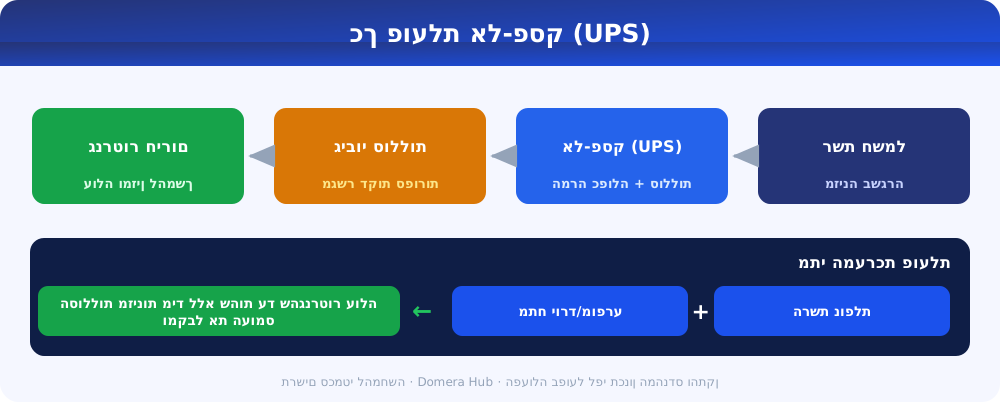
At its core, a UPS is a combination of three components: a charger/rectifier (Rectifier) that converts the grid voltage (AC) to direct voltage (DC) and charges the batteries; a battery string (Battery String) that stores energy; and an inverter (Inverter) that converts the battery voltage back to clean, stable AC for the consumer. Around these there is a bypass circuit that allows feeding the consumer directly from the grid during maintenance or a fault.
In the configuration common in critical spaces — online / Double-Conversion — the current always passes through the rectifier and the inverter, even when the grid is sound. Thus the consumer receives "rebuilt" power, completely isolated from disturbances, surges and voltage fluctuations in the grid. The moment the grid fails, there is no transfer or delay: the batteries are already feeding the same inverter, and the consumer does not feel a thing. This is the fundamental difference from a generator, which requires seconds until it comes up and stabilizes.
The most important point for understanding the role of the UPS is the triple backup sequence: grid ← UPS ← generator. The UPS is not intended to hold the building for hours; it is intended to hold for a few minutes — exactly the time it takes for the emergency generator to come up, stabilize and take the load through the ATS. Therefore the UPS and the generator are not interchangeable but complementary: the UPS covers the "hole" of the first zero seconds in which the generator is not yet ready. After the generator stabilizes, it feeds both the consumer and the UPS charger, so that the batteries recharge and are ready for the next event.
The backup time (Autonomy) of the UPS derives from the size of the battery string versus the load — and therefore worn batteries quietly shorten the backup time, without a visible warning, until on a day of a real outage they collapse earlier than expected.
Why the System Is Needed + Risks of Neglect
The value of a UPS is clear anywhere that even a voltage drop of a fraction of a second is unacceptable. Typical environments:
- Server rooms and data centers — a momentary voltage drop = server crash, data loss and a lengthy recovery. Here the UPS is critical infrastructure that cannot be foregone.
- Control, safety and communications systems — building control panels, communications exchanges and security systems whose loss of power paralyzes the building.
- Equipment sensitive to electrical disturbances — instrumentation that voltage surges and grid fluctuations damage over time; the double conversion isolates it from all of these.
The risk of neglect here is unique and misleading. First, and this is the most common fault: batteries wear out quietly. A string that looks "fine" with a green light may in fact hold a small fraction of the original backup time — and this is discovered only at the moment of truth, too late. Second, a failure in the inverter or the bypass circuit may drop the consumer even when the grid is sound. Third, this is an electrical installation for all intents and purposes, and a failure in it is also a safety risk (heat, short circuit, batteries). And finally — since the UPS is the link that bridges to the generator, a failure in it disconnects the entire backup sequence even if the generator itself is sound.
The Maintenance Regime — What, How Often, and How
The UPS has two completely separate inspection tracks, in two disciplines and at two frequencies — and this is the critical point where it is easy to slip:
- Service and maintenance inspection — once every six months (every 6 months). A routine functional inspection performed by an authorized maintenance company on behalf of the manufacturer. Here they check the condition of the battery string, the inverter and the charger, perform a discharge/load test to verify the backup time, and detect worn batteries before they collapse. The document to keep: a service report. This inspection is recommended (not a legal requirement), but it is the one that in practice keeps the system available.
- Inspection of the UPS's electrical installation — once every five years (every 60 months). An inspection of the UPS as an electrical installation by a testing electrician holding a license matched to the size of the connection. The document to keep: an electrical installation inspection certificate. This inspection is a legal (statutory) requirement.
The distinction between the two is essential: the semi-annual inspection by the maintenance company preserves the function (especially the batteries), and the five-yearly inspection by the testing electrician is the one that closes the legal requirement as an electrical installation. Whoever documents only the manufacturer's service report and not the testing electrician's certificate may be non-compliant. And the opposite: whoever has only a testing electrician's certificate from two years ago but has not checked the batteries may discover in a real outage that the backup collapsed.
Who Is Authorized to Maintain and Certify
The authorizations are divided by the nature of the inspection, and this is essential:
- Service maintenance (semi-annual) — performed by an authorized maintenance company on behalf of the equipment manufacturer. The link to the manufacturer is important: battery strings, inverters and charging protocols are model-specific, and improper servicing may shorten the batteries' life.
- Electrical installation inspection (five-yearly) — performed by a testing electrician holding a license matched to the size of the connection. This is not an ordinary licensed electrician but a testing electrician, holding certification and a license at the level appropriate to the size of the installation's electrical connection.
In short: one certificate is not enough. A well-managed UPS requires two documents from two different professionals — the service report from the maintenance company on behalf of the manufacturer, and the electrical installation inspection certificate from the testing electrician.
Standards and Regulation
Inspecting the UPS as an electrical installation by a testing electrician is a legal (statutory) requirement, and is performed once every five years. The semi-annual service and maintenance inspection on behalf of the manufacturer is recommended and is not anchored as a legal requirement — but it has the highest operational value for keeping the system available.
Beyond that, the UPS is part of the building's electrical array and is subject to the principles of electrical-installation inspection and the current manufacturer guidance. There is no unique Israeli Standard number or dedicated fire form in our requirements matrix that is explicitly directed at the UPS — and therefore we will not cite here a specific "SI" for the UPS, but will refer generally to the electrical installation inspection, the standard and the manufacturer and authority guidance. For broader background on electrical-installation inspections in the building, see building electrical system maintenance.
Required Documentation and Forms
Two documents uphold the availability and compliance of the UPS, and both must be kept and valid:
- Electrical installation inspection certificate — the output of the five-yearly inspection by the testing electrician. This is the statutory document.
- Service report — the output of the semi-annual inspection by the maintenance company on behalf of the manufacturer, including the condition of the batteries and the measured backup time.
Manage the two documents as two live files with a separate expiration date for each. Pay special attention to the service report: it usually states the backup time measured in practice and the condition of the batteries — the best early-warning indicator before a battery string reaches the end of its life.
Common Faults and Warning Signs
- A backup time that keeps shortening — the classic sign of worn batteries. If the service report shows a decline in the Autonomy indicator — the batteries are nearing the end of their life.
- A battery replacement light / alarm — do not ignore; a string at end of life will not provide the backup time even if "everything looks fine."
- The system moved to Bypass and did not return — this means the consumer is fed directly from the grid without UPS protection; a grid failure at such a moment = a consumer failure.
- Abnormal heat, odor or battery swelling — a real safety sign; batteries may leak or overheat. The maintenance company must be summoned immediately.
- "There is a service report but no testing electrician's certificate" — or the opposite — one of the common documentation faults: managing one track and forgetting the other.
The Value of Professional Maintenance Management / How Domera Helps
The UPS is a perfect example of a system that is easy to neglect because it "works on its own" — until the day it doesn't. Two inspection tracks, two frequencies (semi-annual and five-yearly), two professionals, two documents and two expiration dates — and every miss leaves a critical space without a real backup. Domera's Knowledge Hub is designed precisely to help the building manager see this picture clearly.
In practice, in the Domera system the UPS is managed through a preventive-maintenance program (PPM): each inspection opens one instance that is open at any given moment, and closing it requires attaching the certifying document (the service report or the electrical installation inspection certificate). The system sends reminders before expiration — separately for each of the two tracks, so that the five-yearly inspection does not "vanish" between the years — and produces compliance reports that show exactly what is valid and what is overdue. The idea is simple: not to rely on a green light, but on a system that closes the loop against the document and the measurement.
Frequently Asked Questions
What is the difference between a UPS and an emergency generator?
The UPS bridges the first zero seconds of a power outage from batteries, without any delay. The generator takes seconds to tens of seconds to come up and stabilize, and is intended to hold over time. The two are complementary: the UPS covers the gap until the generator comes up, and then the generator feeds both the consumer and the charging of the UPS.
Why do you need both a UPS and a generator?
Because they answer a different need. A generator alone leaves a "hole" of seconds until it comes up — a period that drops servers and sensitive equipment. A UPS alone holds only a few minutes. Together they create a continuous sequence: UPS for the first moments, generator for the rest.
How often must a UPS be inspected?
Two tracks: a service and maintenance inspection once every six months by an authorized maintenance company on behalf of the manufacturer (recommended), and an electrical installation inspection once every five years by a testing electrician (a legal requirement). Both are important — one for function, the other for legal compliance.
Who is authorized to inspect and certify the UPS?
The service inspection is performed by an authorized maintenance company on behalf of the equipment manufacturer. The electrical installation inspection is performed by a testing electrician holding a license matched to the size of the connection. These are two different professionals in two disciplines.
Why are the batteries the most important part to maintain?
Because the battery string wears out quietly. A system that looks sound may in fact hold a small fraction of the original backup time, and this is discovered only in a real outage. The semi-annual service inspection measures the backup time in practice and detects batteries at the end of their life before they collapse.
What is backup time (Autonomy) and why does it change?
The backup time is the duration for which the UPS can feed the consumer from the batteries alone. It derives from the size of the battery string versus the load, and shortens as the batteries wear out. Therefore it is important to measure it in the service inspection and not to rely on the original value.
Which documents must be kept?
Two documents: an electrical installation inspection certificate (from the five-yearly inspection by the testing electrician — the statutory document), and a service report (from the semi-annual inspection by the maintenance company on behalf of the manufacturer). Both must be valid.
How does Domera help manage this?
Through a preventive-maintenance program (PPM): one open instance per inspection, closing against the certifying document, separate reminders before expiration for each of the two tracks, and compliance reports that show exactly what is valid and what is overdue.
Further Reading
- The PPM Guide — how to build a complete preventive-maintenance program for a building, with all the frequencies and documents.
- Emergency generator maintenance — the large backup that the UPS bridges to; the triple backup sequence.
- Building electrical system maintenance — the broad background of the electrical-installation inspections that the UPS is part of.
- Managing a server room in a building — cooling, power and backup in the space where the UPS is most critical.
- Knowledge Hub — all the guides on building systems in one place.
Frequently asked questions
What is the difference between a UPS and an emergency generator?
The UPS bridges the first zero seconds of a power outage from batteries, without any delay. The generator takes seconds to tens of seconds to come up and stabilize, and is intended to hold over time. The two are complementary: the UPS covers the gap until the generator comes up, and then the generator feeds both the consumer and the charging of the UPS.
Why do you need both a UPS and a generator?
Because they answer a different need. A generator alone leaves a "hole" of seconds until it comes up — a period that drops servers and sensitive equipment. A UPS alone holds only a few minutes. Together they create a continuous sequence: UPS for the first moments, generator for the rest.
How often must a UPS be inspected?
Two tracks: a service and maintenance inspection once every six months by an authorized maintenance company on behalf of the manufacturer (recommended), and an electrical installation inspection once every five years by a testing electrician (a legal requirement). Both are important — one for function, the other for legal compliance.
Who is authorized to inspect and certify the UPS?
The service inspection is performed by an authorized maintenance company on behalf of the equipment manufacturer. The electrical installation inspection is performed by a testing electrician holding a license matched to the size of the connection. These are two different professionals in two disciplines.
Why are the batteries the most important part to maintain?
Because the battery string wears out quietly. A system that looks sound may in fact hold a small fraction of the original backup time, and this is discovered only in a real outage. The semi-annual service inspection measures the backup time in practice and detects batteries at the end of their life before they collapse.
What is backup time (Autonomy) and why does it change?
The backup time is the duration for which the UPS can feed the consumer from the batteries alone. It derives from the size of the battery string versus the load, and shortens as the batteries wear out. Therefore it is important to measure it in the service inspection and not to rely on the original value.
Which documents must be kept?
Two documents: an electrical installation inspection certificate (from the five-yearly inspection by the testing electrician — the statutory document), and a service report (from the semi-annual inspection by the maintenance company on behalf of the manufacturer). Both must be valid.
How does Domera help manage this?
Through a preventive-maintenance program (PPM): one open instance per inspection, closing against the certifying document, separate reminders before expiration for each of the two tracks, and compliance reports that show exactly what is valid and what is overdue.