In this article
- How the System Works
- Why the System Is Needed + Risks of Neglect
- The Maintenance Regime — What, How Often, and How
- Who Is Authorized to Maintain and Certify
- Standards and Regulation
- Required Documentation and Forms
- Common Faults and Warning Signs
- The Value of Professional Maintenance Management / How Domera Helps
- Frequently Asked Questions
- Further Reading
- Frequently asked questions
Backflow Preventer (BFP)
A backflow preventer (BFP) is a hydraulic device installed on the water piping that prevents water from flowing in the reverse direction — that is, it prevents contaminated water from inside the building from returning to the municipal drinking-water network. Its role is a one-way safety barrier: water enters the building, but can never flow back out and contaminate the public source — and so this is one of the smallest in scope yet most critical of the tests in terms of public health and the law.
For a building manager or maintenance engineer, the BFP is a "transparent" component — a small device in a pump room or at the water entry that usually no one pays attention to, until an inspector arrives or contamination is discovered. But the BFP test is an annual legal requirement with a dedicated authorized party, and failing to comply exposes the building to heavy legal and health liability. In this article we explain how the system works, why it is needed, what the required maintenance regime is in Israel, who is authorized to test and certify it, and how to manage it without falling through the cracks.
Part of a bigger picture: the BFP test is one component within a complete preventive maintenance program. For the full framework — all systems, frequencies, authorized parties, and forms — see the complete PPM guide.
How the System Works
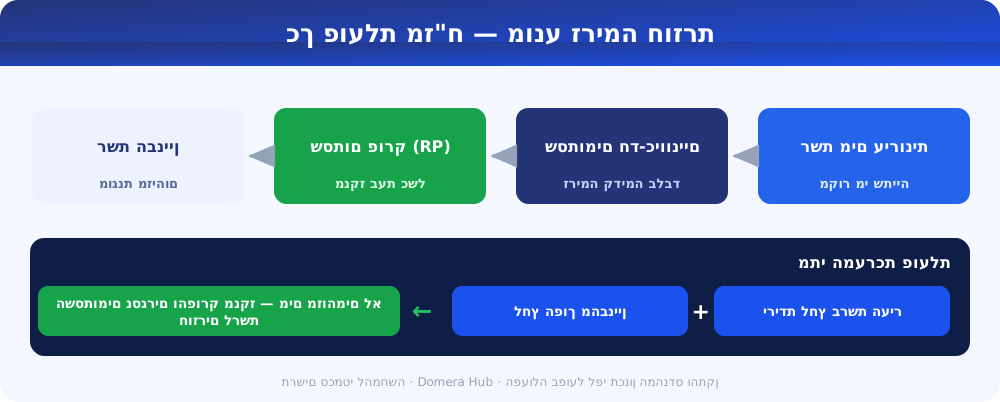
The BFP is usually installed at the connection point between the building's water network and the city network — at the main water entry, as well as on internal systems with a high contamination risk. Its operating principle is simple: it allows flow in one direction only (from the city to the building), and blocks any attempt at reverse flow.
The backflow that the BFP prevents is caused mainly in two conditions: Back-siphonage — a sudden pressure drop in the city network (for example following a break in a municipal pipe or strong pumping nearby) that creates reverse "suction" drawing water from the building into the network; and Back-pressure — a condition in which pressure in an internal building system (a pump, pressure tank, boiler) is higher than the network pressure and pushes water back out. In both cases, without a BFP, water that has already "touched" the building — and may have been exposed to substances or contaminated systems — can return to the public drinking water.
In terms of internal structure, a BFP contains two check valves in series, and in the stricter types also a reduced-pressure zone with a relief valve between them. This relief valve is the heart of the advanced BFP type: if both valves leak simultaneously and pressure begins to return, the relief valve opens and drains the water out to open air — so that contaminated water is "spilled" out rather than returning to the network. The two common types are RP (Reduced Pressure) for high contamination risks, and DC (Double Check) for lower risks. The risk classification and the required BFP type are set according to the protected system and the guidelines of the competent authority.
The BFP is closely tied to the building's other water and plumbing systems: it protects the drinking-water reservoir and the city network from contamination originating in internal risk systems — mainly the fire-suppression systems (where the water is standing and contains additives), cooling towers and chillers (chemical and Legionella risk), irrigation, and industrial systems.
Why the System Is Needed + Risks of Neglect
The value of the BFP is protecting public health. Without it, a single pressure event in the city network may draw hazardous substances into the public drinking water — chemicals from a cooling tower, water additives from a fire-suppression system, herbicides from an irrigation system, or contaminated water from an industrial system. This is contamination that may affect not only the building's occupants, but the entire neighborhood connected to the same water line.
The risks of neglecting the BFP accumulate on several planes:
- Health — a stuck BFP, a leaking valve, or a blocked relief valve mean the barrier is no longer working; contamination may return to the network without anyone knowing.
- Legal and regulatory — the test is statutory (a legal requirement). The absence of a valid BFP test certificate = non-compliance with the authority, and even grounds for disconnecting the water supply in certain cases.
- Safety-operational — a blocked or improperly installed BFP may obstruct flow, impair the building's water pressure, and even disrupt the fire-suppression systems that rely on a proper water supply.
- Personal liability — in the event of a contamination incident, the building manager and the house committee may bear liability if it emerges that the annual test was not carried out.
The Maintenance Regime — What, How Often, and How
The BFP has a clear and focused testing regime:
- BFP test — annual (every 12 months). This is a mandatory statutory test applying to every site. The test includes a functional examination of the check valves, the relief valve (in the RP type), tightness, pressures, and proof that the BFP indeed blocks backflow. The test is performed with dedicated measuring equipment (a calibrated pressure-gauge kit).
- The document to keep: the BFP test certificate — the official output of the annual test, signed by the authorized party.
Beyond the formal annual test, it is recommended that the maintenance manager include the BFP in the ongoing visual inspection round — to verify that there is no leak from the relief valve (a sign of a valve fault), that there is no corrosion, and that access to it is clear. But the functional test and the certificate can be performed only by an authorized party, and cannot be replaced by a self-check.
Who Is Authorized to Maintain and Certify
The BFP test and its certification are performed solely by a licensed backflow-preventer installer — a professional specifically trained and certified for the installation and periodic testing of backflow preventers, who holds the required calibrated measuring equipment. This is not a "general plumber": a BFP test requires dedicated certification and knowledge of the standard and the competent authority's guidelines.
The licensed installer is the one who issues the BFP test certificate, which is the document determining compliance. Do not accept a test performed by a party who is not a licensed backflow-preventer installer — it will not count as compliance with the legal requirement.
Standards and Regulation
The BFP test is a legal (statutory) requirement applying to every site, and its frequency is once a year. The BFP installation, the risk-level classification, the required device type (RP or DC), and the periodic test are subject to the current standard and the guidelines of the authority and the manufacturer and to the requirements of the water supplier / local water corporation, which are responsible for the integrity of the public drinking-water network.
An important clarification: in our requirements matrix the test is defined as annual, statutory, by a licensed backflow-preventer installer, with a BFP test certificate as the binding document — but it contains no SI standard number or specific clause directed at the BFP. Therefore we do not cite a particular standard number here, and refer generally to the standard, the authority's guidelines, and the water corporation's requirements. The exact classification and the relevant standard are determined by the licensed installer according to the protected system.
Required Documentation and Forms
The only document that holds the BFP's compliance is the BFP test certificate — the output of the annual test signed by the licensed installer. Manage it as a live file with an expiry date, since the test is renewed each year.
The BFP has no dedicated fire form (unlike fire-suppression systems, many of which have a uniform form from the national fire and rescue authority) — the binding documentation is the BFP test certificate issued by the licensed installer. To an inspector, water corporation, or investigator in the event of a contamination incident — the valid certificate is the proof that the barrier was tested and is functional.
Common Faults and Warning Signs
- Continuous leaking from the relief valve (RP) — a clear sign of a fault: one of the check valves is leaking and the relief valve is releasing water in order to protect. Requires immediate treatment by a licensed installer.
- A drop in the building's water pressure — a blocked BFP (deposits, corrosion) may obstruct proper flow and impair supply.
- A BFP installed in the reverse direction or in the wrong place — incorrect installation completely nullifies the protection; an initial inspection by a licensed installer will expose it.
- Blocked access to the BFP — a device buried behind equipment or sealed in a niche cannot be tested or serviced in time.
- "An expired or missing certificate" — the common documentation fault: the BFP exists and may even be functional, but there is no valid test certificate — and in terms of the law this is non-compliance.
- Freezing / mechanical damage — a BFP installed outdoors without protection may be damaged by cold or a blow and lose its tightness.
The Value of Professional Maintenance Management / How Domera Helps
The BFP is a classic example of a "small and forgotten" component that falls between the cracks: one test a year, a dedicated authorized party, and a single certificate with an expiry date — and every miss leaves the building non-compliant and the water network without protection. Domera's Knowledge Hub is designed to help the building manager see these components before they become a problem.
In practice, in the Domera system the BFP test is managed through a preventive maintenance program (PPM): for the test, one open instance exists at any given moment, and closing it requires attaching the certifying BFP test certificate. The system sends a reminder before expiry — so that the annual test is renewed on time and not at the last minute — and produces compliance reports showing exactly whether the certificate is valid. The idea is simple: not to rely on memory, but on a system that closes the loop against the document.
Frequently Asked Questions
What is a BFP and why is it important?
A backflow preventer (BFP) is a one-way device on the water piping that prevents contaminated water from inside the building from returning to the municipal drinking-water network. It is important because it protects public health — without it, a pressure event in the network may draw contamination from the building into the drinking water of an entire neighborhood.
How often must a BFP be tested?
A BFP test is an annual legal requirement — once every 12 months — and is performed by a licensed backflow-preventer installer. The test applies to every site, and at its end a BFP test certificate is issued that must be kept valid.
Who is authorized to test and certify a BFP?
Only a licensed backflow-preventer installer — a professional specifically trained for the installation and periodic testing of backflow preventers and holding calibrated measuring equipment. A general plumber without this certification is not permitted to issue a BFP test certificate.
What is the difference between an RP-type BFP and a DC-type BFP?
An RP (Reduced Pressure) BFP includes a reduced-pressure zone with a relief valve that drains water out upon failure, and is intended for high contamination risks. A DC (Double Check) BFP is based on two check valves only, and is intended for lower risks. The device type is set according to the risk classification of the protected system.
Where must a BFP be installed in a building?
Usually at the main water entry (between the building network and the city network), as well as on internal systems with a high contamination risk — fire-suppression systems, cooling towers and chillers, irrigation systems, and industrial systems. The exact classification is set according to the standard and the authority's guidelines.
What happens if the BFP is not tested?
The absence of a valid BFP test certificate means non-compliance with the authority and the water corporation, and even possible grounds for disconnecting the water supply in certain cases. Beyond the law — an untested BFP may be faulty without anyone knowing, and leave the water network exposed to contamination.
What is a leak from the relief valve and what does it signal?
In an RP-type BFP, a continuous water leak from the relief valve is a clear warning sign: one of the check valves is leaking, and the relief valve is releasing water in order to maintain the protection. This is a fault that requires immediate treatment by a licensed backflow-preventer installer.
How does Domera help manage the BFP test?
Through a preventive maintenance program (PPM): one open instance per test, closing against the certifying BFP test certificate, a reminder before expiry to renew the annual test on time, and compliance reports showing exactly whether the certificate is valid.
Further Reading
- The PPM guide — how to build a complete preventive maintenance program for the building, across all systems and forms.
- Backflow preventer, Legionella, and the fire-suppression reservoir — maintaining water systems, the drinking-water reservoir, and the biological contamination risks.
- Maintaining water and plumbing systems — the broad picture of water supply, piping, and pumps in the building.
- Chiller and cooling-tower maintenance — the air-conditioning and cooling systems the BFP protects the network from contamination originating in them.
- The Knowledge Hub — all the guides on building systems in one place.
Frequently asked questions
What is a BFP and why is it important?
A backflow preventer (BFP) is a one-way device on the water piping that prevents contaminated water from inside the building from returning to the municipal drinking-water network. It is important because it protects public health — without it, a pressure event in the network may draw contamination from the building into the drinking water of an entire neighborhood.
How often must a BFP be tested?
A BFP test is an annual legal requirement — once every 12 months — and is performed by a licensed backflow-preventer installer. The test applies to every site, and at its end a BFP test certificate is issued that must be kept valid.
Who is authorized to test and certify a BFP?
Only a licensed backflow-preventer installer — a professional specifically trained for the installation and periodic testing of backflow preventers and holding calibrated measuring equipment. A general plumber without this certification is not permitted to issue a BFP test certificate.
What is the difference between an RP-type BFP and a DC-type BFP?
An RP (Reduced Pressure) BFP includes a reduced-pressure zone with a relief valve that drains water out upon failure, and is intended for high contamination risks. A DC (Double Check) BFP is based on two check valves only, and is intended for lower risks. The device type is set according to the risk classification of the protected system.
Where must a BFP be installed in a building?
Usually at the main water entry (between the building network and the city network), as well as on internal systems with a high contamination risk — fire-suppression systems, cooling towers and chillers, irrigation systems, and industrial systems. The exact classification is set according to the standard and the authority's guidelines.
What happens if the BFP is not tested?
The absence of a valid BFP test certificate means non-compliance with the authority and the water corporation, and even possible grounds for disconnecting the water supply in certain cases. Beyond the law — an untested BFP may be faulty without anyone knowing, and leave the water network exposed to contamination.
What is a leak from the relief valve and what does it signal?
In an RP-type BFP, a continuous water leak from the relief valve is a clear warning sign: one of the check valves is leaking, and the relief valve is releasing water in order to maintain the protection. This is a fault that requires immediate treatment by a licensed backflow-preventer installer.
How does Domera help manage the BFP test?
Through a preventive maintenance program (PPM): one open instance per test, closing against the certifying BFP test certificate, a reminder before expiry to renew the annual test on time, and compliance reports showing exactly whether the certificate is valid.