In this article
- How the system works
- Why the system is needed + risks of neglect
- The maintenance regime — what, how often, and how
- Who is qualified to maintain and certify
- Standards and regulation
- Required documentation and forms
- Common faults and warning signs
- The value of professional maintenance management / how Domera helps
- Frequently asked questions
- Further reading
- Frequently asked questions
Emergency Lighting and Exit Signage — Light and a Way When the Power Fails
Emergency lighting and exit signage are the safety system that switches on automatically the moment the regular power supply fails, illuminating the escape route — the corridors, stairwells and exits — so that people can leave the building safely even in total darkness. That is the reason the system exists: in a fire, a power outage or any emergency event, the combination of smoke and darkness is more dangerous than either alone, and emergency lighting with illuminated "exit" signs is what prevents panic and directs those present toward the way out.
For a building manager or maintenance engineer, this is a particularly deceptive system: most of the time it is off and invisible, and its only fault indicator is a small green light. But just like a fire extinguisher no one has checked — its true value is revealed only at the moment of truth, and at such a moment a drained battery or a burnt-out sign is no longer a technical fault but a threat to life. In this article we explain how the system works, why it is needed, what inspection regime is required in Israel, who is qualified to inspect and certify, and which documents must be kept.
Part of a bigger picture: emergency lighting is one component in a complete preventive maintenance plan. For the full framework — all the systems, frequencies, qualified professionals and documents — see the full PPM guide.
How the system works
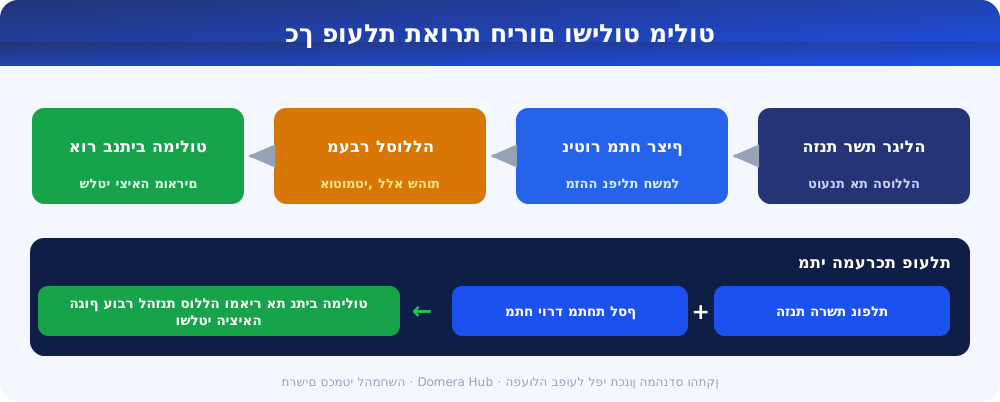
At its core, emergency lighting is a light fixture with an independent energy source that allows it to illuminate even when the main supply has disappeared. The key to understanding the system is the continuous monitoring of the grid voltage: every fixture (or every central unit) constantly checks whether a supply voltage is present. As long as there is power — the battery charges and keeps itself ready. The moment the voltage fails, the system switches automatically and without significant delay to power from the battery, and the fixture switches on and illuminates the escape route.
There are two main architectures. In the self-contained configuration — the most common — each emergency lighting fixture has its own battery and its own control card; it is a completely independent unit. In the central battery configuration — common in large buildings — a central battery array feeds all the emergency fixtures through dedicated infrastructure, which eases monitoring and backup but adds a central point of failure. In both cases the principle is identical: voltage disappears → automatic switch to battery → the light comes on.
A second, separate and no less important component is the exit signage — the illuminated "exit" signs and the arrows directing toward the safe way out. Some signs are always illuminated (with their own battery backup), and some light up only in an emergency. Their role is to make a route that is familiar in routine understandable even to someone in the building for the first time, through smoke and under pressure. In tall buildings the system is also supported by emergency power from the building's electrical system and from the generator backup — but the emergency lighting covers precisely the gap between the grid failure and the moment of stabilization, and the scenarios in which there is no backup supply at all.
Why the system is needed + risks of neglect
The need for emergency lighting arises from a simple and dangerous scenario: an emergency event is almost always accompanied by a loss of power. In a fire the power is cut, in a grid outage the corridors sink into darkness, and in both cases people need to get out — fast, in order, and without being able to see. A dark stairwell where people push in panic is one of the most dangerous scenarios in a building, and emergency lighting and exit signs are the line of defense that prevents it.
The risk of neglect here is especially severe precisely because it is invisible:
- Batteries that have silently drained — this is the common fault. The emergency fixture's battery wears out over the years; a fixture that appears sound with a green control light may in fact hold for only a few seconds instead of the required backup time — and this is discovered only when the power really fails.
- Burnt-out or disconnected fixtures and signs — a burnt-out bulb or an unlit "exit" sign leaves a "dark hole" at exactly a critical point on the escape route.
- Life-safety risk and non-compliance with the law — emergency lighting is a statutory requirement. A building where the system is not sound or that lacks a valid inspection certificate is exposed both to a real threat to life in an emergency, to legal and insurance exposure, and to a refusal to renew approvals.
What all these have in common: they cannot be identified from a fleeting glance. Only an orderly inspection — one that simulates a voltage failure and actually measures that the light comes on and holds for the required time — reveals the fault before it becomes a disaster.
The maintenance regime — what, how often, and how
Emergency lighting has two complementary inspection tracks, and both are important:
- Emergency lighting inspection — once a year (annual). The central periodic inspection, performed by a suitably licensed electrician. Within it, a voltage failure is simulated, it is verified that every fixture switches to battery power and comes on, it is checked that the light holds for the required backup time, and it is confirmed that all exit signs are illuminated and sound. The document to keep: an emergency lighting inspection certificate. This inspection is a legal requirement (statutory) — both in buildings of 10 stories or more and in lower buildings.
- Internal check — once every six months. In addition to the annual inspection, the binding documents also specify a semi-annual internal inspection certificate — an ongoing functional check that verifies the fixtures and signs come on when the supply is disconnected, and detects wearing batteries and bulbs between the annual inspections.
The practical idea: the annual inspection by an electrician closes the legal requirement and produces the official certificate, and the semi-annual internal check is the safety net that catches dead batteries and unlit signs before they are left dormant for half a year. The frequency and applicability details appear in full in the PPM guide, and for any inspection where there is no explicit specification, one must rely on the current authority and manufacturer directive.
Who is qualified to maintain and certify
The periodic inspection of the emergency lighting and the production of the official certificate are within the authority of a suitably licensed electrician. A "suitable license" is not merely technical — it refers to a license appropriate to the nature of the installation and the inspection, and it is what authorizes the professional to sign the emergency lighting inspection certificate.
Since emergency lighting is part of the building's electrical array and of the escape route, it is appropriate to coordinate its inspection with the other electrical installation inspections and with the overall evacuation readiness. The semi-annual internal check can be carried out within the ongoing maintenance, but the statutory certificate comes from the annual inspection by the suitably licensed electrician. When a specific qualification detail is not defined — one must act according to the authority and manufacturer directive, and not assume a qualification that is not written.
Standards and regulation
The emergency lighting inspection is a legal requirement (statutory) in Israel, in both types of building — both in a building of 10 stories or more and in a lower building. This means it is not a recommendation but an obligation, and every building is required to hold a valid emergency lighting inspection certificate.
Emergency lighting is closely tied to the soundness certificate of the electrical system and emergency lighting vis-à-vis the National Fire and Rescue Authority — Form 3: Certificate of soundness of the electrical system and emergency lighting, which brings together the emergency power supply and the emergency lighting as one safety whole. It is important to note: there is no unique SI number explicitly specified for the emergency lighting itself in the binding sources in our possession — so we will not cite a specific "SI" here, but rather refer to the statutory inspection, to Form 3 and to the current standard, authority and manufacturer directive. Any additional compliance requirement — must be derived from the binding source and not invented as a number.
Required documentation and forms
Two types of document hold the emergency lighting's compliance, and both must be kept and valid:
- Emergency lighting inspection certificate — the output of the annual inspection by the suitably licensed electrician. This is the central statutory document, alongside it the semi-annual internal certificate from the functional check.
- Form 3 — Certificate of soundness of the electrical system and emergency lighting — the fire form that brings together the emergency power supply and the emergency lighting. Full explanation, alongside the downloadable PDF, in the dedicated article: Form 3 — Certificate of soundness of the electrical system and emergency lighting.
Manage the documents as living files with a validity date for each, and keep alongside them the list of fixtures and signs that were inspected — so that at the next inspection it is easy to verify that every point on the escape route was indeed inspected and certified.
Common faults and warning signs
- An off or red control light on an emergency fixture — the direct sign of a fault in the battery, the charging or the fixture; do not ignore it, even if the fixture "appears sound."
- The fixture does not come on when the supply is disconnected — the most basic test: if, on a simulated voltage disconnection, the fixture stays off, the battery is dead or the card is faulty. This is the failure the internal check is meant to catch.
- An unlit, burnt-out or obscured "exit" sign — a "dark hole" on the escape route; a sign blocked by furniture or other signage loses its value entirely.
- Diminishing backup time — wearing batteries silently shorten the illumination duration; a fixture that once held the required backup time and now holds a few seconds is nearing the end of its life.
- "There is an annual inspection but no internal check" — or the reverse — a common documentation fault: one relies on a single track and neglects the other, and is left for half a year with faults no one detected.
The value of professional maintenance management / how Domera helps
Emergency lighting is a prime example of a system that is easy to neglect because it is invisible for most of its life — until the moment when it is all that stands between the building's occupants and dark stairs in smoke. Two inspection tracks (annual statutory + semi-annual internal), a certificate that must be renewed, and a list of fixtures and signs each of which can fail silently — all of these require orderly tracking, not reliance on a green light. Domera's Knowledge Center is meant to help the building manager see this picture clearly.
In practice, in the Domera system emergency lighting is managed through a preventive maintenance (PPM) plan: for each inspection a single open instance is opened at any given moment, and closing it requires attaching the certifying document — the emergency lighting inspection certificate. The system sends reminders before the certificate's validity expires, so that the annual inspection is not dropped, and produces compliance reports that show exactly which systems are valid and which are out of compliance. The idea is simple: close the loop against the document and the inspection — do not rely on a light no one has checked.
Frequently asked questions
What is emergency lighting and why is it important?
Emergency lighting is a lighting system that switches on automatically the moment the regular power supply fails, illuminating the escape route — corridors, stairwells and exits. It is important because an emergency event (a fire, a power outage) is almost always accompanied by a loss of power, and emergency lighting with the illuminated exit signs is what enables people to get out safely even in the dark.
How often must emergency lighting be inspected?
Two tracks: an emergency lighting inspection once a year by a suitably licensed electrician (a legal requirement, producing the official certificate), and an internal check once every six months that verifies ongoing function and detects wearing batteries and bulbs between the annual inspections.
Who is qualified to inspect and certify emergency lighting?
The periodic inspection and the production of the emergency lighting inspection certificate are within the authority of a suitably licensed electrician. The semi-annual internal check can be carried out within the ongoing maintenance, but the statutory certificate comes from the annual inspection by the electrician.
What is the difference between a self-contained and a central configuration?
In a self-contained configuration each emergency lighting fixture has its own battery and control — a completely independent unit, and the most common. In a central battery configuration a central battery array feeds all the fixtures through dedicated infrastructure — convenient for monitoring but adding a central point of failure. The principle in both is identical: voltage disappears → automatic switch to battery → the light comes on.
Why are the batteries the most important part to inspect?
Because the emergency fixture's battery wears out silently. A fixture that appears sound with a green control light may in fact hold for only a few seconds instead of the required backup time, and this is discovered only when the power really fails. Only an inspection that simulates a voltage failure and actually measures the illumination time reveals the fault in time.
Is emergency lighting a legal requirement?
Yes. The emergency lighting inspection is a statutory requirement in both types of building — both in a building of 10 stories or more and in a lower building. Every building is required to hold a valid emergency lighting inspection certificate.
What is the connection between emergency lighting and Form 3?
Form 3 of the National Fire and Rescue Authority is a certificate of soundness of the electrical system and emergency lighting, which brings together the emergency power supply and the emergency lighting as one safety whole. Full explanation and downloadable file in the dedicated article for Form 3.
Which documents must be kept?
The emergency lighting inspection certificate (from the electrician's annual inspection — the statutory document) alongside the semi-annual internal certificate, and Form 3 (Certificate of soundness of the electrical system and emergency lighting) when required. It is worth keeping alongside them the list of fixtures and signs that were inspected.
Further reading
- The PPM guide — how to build a complete preventive maintenance plan for the building, with all the frequencies, qualified professionals and documents.
- Form 3 — Certificate of soundness of the electrical system and emergency lighting — the form that brings together the emergency power supply and the emergency lighting, with a downloadable file.
- Maintenance of the building's electrical systems — the broad background of the electrical array of which emergency lighting is part.
- Emergency and evacuation procedures in the building — how emergency lighting and exit signs integrate into the overall evacuation readiness.
- Knowledge Center — all the guides on building systems in one place.
Frequently asked questions
What is emergency lighting and why is it important?
Emergency lighting is a lighting system that switches on automatically the moment the regular power supply fails, illuminating the escape route — corridors, stairwells and exits. It is important because an emergency event (a fire, a power outage) is almost always accompanied by a loss of power, and emergency lighting with the illuminated exit signs is what enables people to get out safely even in the dark.
How often must emergency lighting be inspected?
Two tracks: an emergency lighting inspection once a year by a suitably licensed electrician (a legal requirement, producing the official certificate), and an internal check once every six months that verifies ongoing function and detects wearing batteries and bulbs between the annual inspections.
Who is qualified to inspect and certify emergency lighting?
The periodic inspection and the production of the emergency lighting inspection certificate are within the authority of a suitably licensed electrician. The semi-annual internal check can be carried out within the ongoing maintenance, but the statutory certificate comes from the annual inspection by the electrician.
What is the difference between a self-contained and a central configuration?
In a self-contained configuration each emergency lighting fixture has its own battery and control — a completely independent unit, and the most common. In a central battery configuration a central battery array feeds all the fixtures through dedicated infrastructure — convenient for monitoring but adding a central point of failure. The principle in both is identical: voltage disappears, automatic switch to battery, and the light comes on.
Why are the batteries the most important part to inspect?
Because the emergency fixture's battery wears out silently. A fixture that appears sound with a green control light may in fact hold for only a few seconds instead of the required backup time, and this is discovered only when the power really fails. Only an inspection that simulates a voltage failure and actually measures the illumination time reveals the fault in time.
Is emergency lighting a legal requirement?
Yes. The emergency lighting inspection is a statutory requirement in both types of building — both in a building of 10 stories or more and in a lower building. Every building is required to hold a valid emergency lighting inspection certificate.
What is the connection between emergency lighting and Form 3?
Form 3 of the National Fire and Rescue Authority is a certificate of soundness of the electrical system and emergency lighting, which brings together the emergency power supply and the emergency lighting as one safety whole. Full explanation and downloadable file in the dedicated article for Form 3.
Which documents must be kept?
The emergency lighting inspection certificate (from the electrician's annual inspection — the statutory document) alongside the semi-annual internal certificate, and Form 3 (Certificate of soundness of the electrical system and emergency lighting) when required. It is worth keeping alongside them the list of fixtures and signs that were inspected.