
In this article
- How the system works
- Why the system is necessary + risks of neglect
- The maintenance regime — what, how often, and how
- Who is qualified to maintain and certify
- Standards and regulation
- Required documentation and forms
- Common faults and warning signs
- The value of professional maintenance management / how Domera helps
- Frequently asked questions
- Further reading
- Frequently asked questions
Passive fire separation measures are construction components whose function is to block the spread of fire and smoke between parts of the building — first and foremost fire doors and penetration sealing (shafts, technical rooms and safe rooms) through which cables, piping and ducts pass. Their importance lies in the fact that they divide the building into separate "fire compartments," thereby buying precious minutes for evacuating the residents and for the arrival of the fire crews, limiting the damage to one area and preventing a local fire from becoming a disaster across the whole building.
Want to understand how passive fire protection fits into an orderly preventive maintenance program for the building? Read the complete PPM guide — the process, the matrix and the inspection frequencies for every system.
How the system works
Unlike active suppression systems that operate only when a fire breaks out (sprinklers, detection, extinguishers), passive fire protection operates all the time, with no moving parts and no electricity. It is built into the structure itself: walls and floors with fire resistance define the boundaries of "fire compartments," and every opening in such a boundary must remain sealed against fire and smoke to the same degree as the wall around it. The two main components the maintenance manager is responsible for are the fire doors and the seals.
A fire door is a complete assembly — leaf, frame, hinges, lock and door closer — designed to withstand the passage of fire and smoke for a defined period. The door closer ensures that the door closes by itself after every passage; a fire door blocked in the open position completely loses its function. Intumescent seals around the perimeter of the leaf expand in heat and close the gaps through which smoke would penetrate.
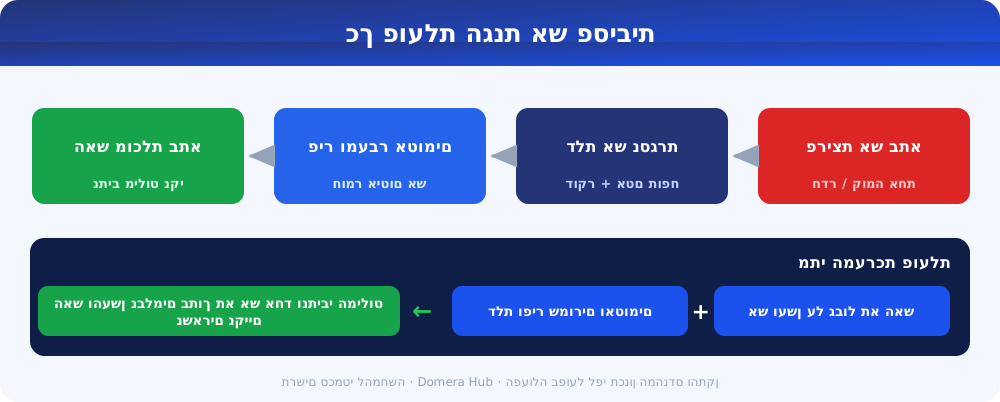
Fire penetration sealing (firestopping) is the plugging of every hole and crack created when a cable, pipe or duct crosses a wall or floor with fire resistance — in shafts, technical rooms and passages. The sealing is done with dedicated materials (fire plaster, foam, intumescent pillows and collars) that restore the fire resistance of the partition precisely at the point that was penetrated. An unsealed hole, even a small one, renders the entire wall ineffective: fire and smoke flow through it exactly as they would flow through an open door. Together, the doors and the seals complement the operation of the automatic suppression systems and the fire and smoke detection system — these detect and extinguish, and passive fire protection contains what has already broken out.
Why the system is necessary + risks of neglect
Most casualties in building fires are harmed by smoke, not by flames. A fire compartment whose boundaries are intact keeps the escape routes — stairwells, corridors — clear of smoke long enough to evacuate people, and that is exactly the purpose of a self-closing fire door and a sealed shaft. The moment the boundary is breached, fire and smoke spread vertically through the shafts and horizontally through the corridors, and what was a fire in one room becomes an event across the whole building.
Neglecting passive fire protection is dangerous precisely because it is quiet and invisible. A fire door whose closer was removed so that it "stays open for convenience," a broken hinge, a peeled intumescent seal, or a communications contractor who ran a new cable through a shaft and left a gaping hole behind — all of these neutralize the protection without anyone noticing, until the fire. Beyond the danger to life, the separation measures are part of the building's safety requirements: a faulty fire compartment is documented as a deficiency in inspection, may impair insurance coverage in the event of damage, and puts the building manager and property owners at exposure. It is important to be familiar with the general safety obligations under the fire safety law and regulations that apply to the building.
The maintenance regime — what, how often, and how
Per the preventive maintenance matrix, passive fire protection is divided into two separate periodic inspections, both applying to every site and both performed internally:
- Fire door soundness — semi-annual (once every six months). In each door it is checked that it closes fully by itself by the force of the closer, that the lock and hinges are sound, that the intumescent seals are in place and have not peeled, that there are no abnormal gaps around the leaf, and that the door is not blocked or held open. Deficiencies are repaired and the inspection is documented in an internal form.
- Fire penetration sealing (shafts, technical rooms, safe rooms) — annual (once a year). All the openings where cables, piping and ducts pass through fire partitions are surveyed, new holes created since the previous survey are located (especially after communications, electrical or plumbing work), and the sealing is completed. The finding is documented in an internal declaration on the inspection of fire penetration sealing in technical rooms.
Both inspections are defined in the matrix as recommended and not as a formal legal requirement, but in practice an intact fire compartment is a condition for the soundness of the other fire systems and for passing inspection — and so they must not be forgone. The exact frequencies of all the building's systems can be seen in the matrix in the PPM guide.
Who is qualified to maintain and certify
Unlike active suppression systems that require a licensed maintenance company holding a standards mark, the inspection of the fire doors and the penetration sealing is performed, per the matrix, by a maintenance worker of the building, and the documentation is internal (an internal form for the doors and an internal declaration for the sealing). This is an ongoing responsibility of the maintenance manager: to verify that the doors close and that the shafts are sealed. That said, when it comes to the initial installation of fire separation measures, the replacement of a fire door, or the re-sealing of shafts after significant work, it is customary and correct to enlist a specialized professional party to perform the work with approved materials and per the current standard and the guidance of the authority and manufacturer — so that the internal inspection can rely on a sound installation.
Standards and regulation
Fire doors and fire-sealing materials are required to meet a defined fire resistance (per a rating of minutes against fire and smoke), in accordance with the standard and the guidance of the National Fire and Rescue Authority and the current manufacturer for the installed component. It is important to use only approved components and sealing materials that have been approved for the specific system — a fire door fitted with hinges or a lock that are not fire-rated, or a shaft sealed with ordinary foam, lose their rating. In the maintenance matrix both inspections are marked as "recommended" and not as statutory, and so in this article we do not cite an SI number or a specific clause; one should rely on the standard and the guidance of the authority and the manufacturer that apply to the component installed in the building.
Required documentation and forms
The two inspections are not accompanied by a dedicated fire-service form — the documentation is internal, and so it is important to manage it in an orderly way in the building file. In every cycle one must keep: an internal form for inspecting the soundness of the fire doors (the list of doors, their location, the inspection findings and the repairs performed), and an internal declaration on the inspection of the fire penetration sealing in the shafts and technical rooms (locating new holes and completing the sealing). It is recommended to attach before-and-after photographs of every repair and documentation of any external work (communications, electrical, plumbing) that crossed a fire partition — so as to know which shafts to re-inspect. Consistent documentation is the proof that the building preserved the integrity of its fire compartments.
Common faults and warning signs
From the field, these are the signs the maintenance team should watch for on an ongoing basis, not only in the periodic inspection:
- A fire door held open — a wedge, chair or hook holding a fire door open completely neutralizes it; this is the most common and dangerous fault.
- A door closer that was removed or does not close — a door that does not close fully by itself is equivalent to an open door at the moment of truth.
- New holes in shafts and technical rooms — the classic sign after communications or electrical work: a new cable was run and the hole was left gaping without sealing.
- Torn or missing intumescent seals around the perimeter of the door leaf — open a path for smoke even when the door is closed.
- Abnormal gaps around the door, a warped leaf or a loose frame — prevent full sealing.
- Sealing material that has crumbled, cracked or fallen out of an opening that was already treated in the past — requires re-sealing.
The value of professional maintenance management / how Domera helps
Passive fire protection is exactly the kind of responsibility that "disappears" from view: it has no indication, no alarm, and a defect in it is discovered only in a fire or in an inspection. This is where orderly maintenance management comes in. Domera manages a preventive maintenance program for every system with one open instance at any given moment, closes every inspection only against the certifying document (the internal form for the doors and the declaration on the sealing), sends a reminder before the semi-annual or annual inspection is due, and consolidates a compliance report that shows at a glance which inspections were performed and what is still open — so that the building's fire compartments stay intact over time and not only on installation day.
Frequently asked questions
What is the difference between passive and active fire protection?
Active fire protection (sprinklers, detection, extinguishers) detects and extinguishes fire when it breaks out and requires activation. Passive fire protection — fire doors and penetration sealing — operates all the time, with no moving parts and no electricity, and its function is to contain the fire and smoke within a single fire compartment. The two complement each other.
What is a fire compartment and why is it important?
A fire compartment is a part of the building enclosed by walls and floors with fire resistance, so that a fire breaking out within it is blocked and does not spread to the rest of the building. Every door and opening on the boundary of the compartment must preserve the same fire resistance, otherwise the compartment "leaks."
How often are fire doors and penetration sealing inspected?
Per the maintenance matrix: fire door soundness is inspected semi-annually (once every six months), and the fire penetration sealing in shafts and technical rooms is inspected annually (once a year). Both inspections apply to every site.
Who is responsible for performing the inspection?
Per the matrix the inspection is performed by a maintenance worker of the building, with internal documentation. For installation, replacing a door or re-sealing after work it is recommended to enlist a specialized professional party using approved materials.
Why is a small hole in a shaft a problem?
An unsealed hole cancels the fire resistance of the entire partition at that point — fire and smoke flow through it exactly as they would flow through an open door. Therefore every passage of a cable or pipe through a fire partition must be re-sealed with a dedicated material.
Is it permitted to leave a fire door permanently open?
No. A fire door must close by itself. If there is an operational need to keep it open, a magnetic holder connected to the detection system must be installed, which releases the door automatically upon the alarm — not a permanent wedge or hook.
Is a dedicated fire-service form needed for this inspection?
There is no dedicated fire-service form. The documentation is internal: an internal form for inspecting the doors and an internal declaration on the inspection of the penetration sealing, which are kept in the building file.
What do you do when an unsealed hole or a faulty door is discovered?
Treat it immediately — close the hole with approved sealing material or repair the door (closer, seals, hinge) — and document the repair in the internal form. Until the repair, a faulty opening or door is a weak point of the entire fire compartment.
Further reading
- Fire detection and suppression system maintenance — the system that detects the fire and alerts; passive fire protection contains what it detects.
- Sprinkler system maintenance — the active automatic suppression that complements the passive protection within the fire compartment.
- Fire safety law and regulations — the framework of the building's safety obligations within which the integrity of the fire compartments sits.
- The complete PPM guide — the preventive maintenance process and the frequency matrix for all the building's systems.
- Domera's Knowledge Hub — all the guides and articles on building management and maintenance.
Frequently asked questions
What is the difference between passive and active fire protection?
Active fire protection (sprinklers, detection, extinguishers) detects and extinguishes fire when it breaks out and requires activation. Passive fire protection — fire doors and penetration sealing — operates all the time, with no moving parts and no electricity, and its function is to contain the fire and smoke within a single fire compartment. The two complement each other.
What is a fire compartment and why is it important?
A fire compartment is a part of the building enclosed by walls and floors with fire resistance, so that a fire breaking out within it is blocked and does not spread to the rest of the building. Every door and opening on the boundary of the compartment must preserve the same fire resistance, otherwise the compartment "leaks."
How often are fire doors and penetration sealing inspected?
Per the maintenance matrix: fire door soundness is inspected semi-annually (once every six months), and the fire penetration sealing in shafts and technical rooms is inspected annually (once a year). Both inspections apply to every site.
Who is responsible for performing the inspection?
Per the matrix the inspection is performed by a maintenance worker of the building, with internal documentation. For installation, replacing a door or re-sealing after work it is recommended to enlist a specialized professional party using approved materials.
Why is a small hole in a shaft a problem?
An unsealed hole cancels the fire resistance of the entire partition at that point — fire and smoke flow through it exactly as they would flow through an open door. Therefore every passage of a cable or pipe through a fire partition must be re-sealed with a dedicated material.
Is it permitted to leave a fire door permanently open?
No. A fire door must close by itself. If there is an operational need to keep it open, a magnetic holder connected to the detection system must be installed, which releases the door automatically upon the alarm — not a permanent wedge or hook.
Is a dedicated fire-service form needed for this inspection?
There is no dedicated fire-service form. The documentation is internal: an internal form for inspecting the doors and an internal declaration on the inspection of the penetration sealing, which are kept in the building file.
What do you do when an unsealed hole or a faulty door is discovered?
Treat it immediately — close the hole with approved sealing material or repair the door (closer, seals, hinge) — and document the repair in the internal form. Until the repair, a faulty opening or door is a weak point of the entire fire compartment.