In this article
- How the system works
- Why it is needed + risks of neglect
- The maintenance regime — what, how often, and how
- Who is authorized to maintain and certify
- Standards and regulation
- Documentation and forms
- Common faults and warning signs
- The value of professional maintenance management / How Domera helps
- Frequently asked questions
- Further reading
- Frequently asked questions
Forklift — Maintenance, Inspection Report, Licensed Inspector and Operator Licensing
A forklift is a mobile lifting machine used for lifting, moving and storing loads on pallets (storage pallets) in warehouses, service parking areas and a building's operational spaces. Every forklift must undergo a periodic inspection by a licensed lifting-machines inspector who issues an inspection report, and this is a legal requirement: without a valid inspection report — it may not be operated, and on top of it sits a further obligation of a valid operator license.
For a building manager or maintenance engineer, the forklift is "operational" equipment that it is easy to forget is subject to the same strict safety regime as a crane or a lifting platform. In this article we explain how it works, why its neglect is especially dangerous, the maintenance regime in Israel, who is authorized to inspect and certify, and how to manage the inspection-report cycle without falling into a validity gap.
Part of a bigger picture: the forklift is one component within a complete preventive maintenance plan. For the full framework — all the systems, frequencies, authorized parties and documents — see the complete PPM guide.
How the system works
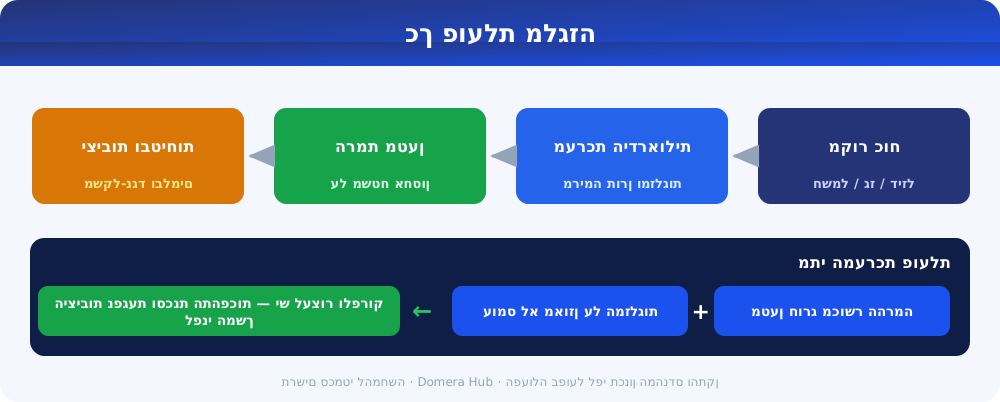
The forklift is built around three mechanisms that work together: a power source, a hydraulic lifting system and a stability system. The power source drives the movement and the hydraulic pump; the pump delivers oil to the pistons that raise the mast and the forks; and stability is maintained by a counterweight in the body of the forklift, which balances the weight of the load in front.
By power source, three main types are distinguished, each with its own maintenance and safety implications:
- Electric forklift (battery) — common for indoor use because it does not emit exhaust gases. Requires battery-array maintenance, correct charging and ventilation of the charging area.
- Gas forklift (LPG) — driven by a gas cylinder, suitable for mixed use. Requires managing the gas cylinders and replacing them safely.
- Diesel forklift — powerful, but emits exhaust gases and therefore is usually intended for use in open areas and not inside a closed building.
In each of the types, the safety chain is the heart of the machine: a load limiter/capacity (how much may be lifted and at what distance from the mast), brakes, horn and signaling, an operator protective cage and a sound hydraulic system without leaks. The role of the licensed inspector's report is to verify that this entire chain is intact — not just that the forklift "lifts and drives".
The forklift belongs to the building's lifting equipment family, alongside lifting machines and lifting platforms — all of which share the same oversight principle: an external licensed inspector who certifies soundness on a periodic cycle, and without a valid certificate — no operation.
Why it is needed + risks of neglect
The need for maintenance here is not "operational convenience" but the safety of human life. The forklift concentrates some of the most dangerous risks in a work environment: tipping over (the leading cause of fatal forklift accidents), crushing/running over pedestrians in a shared area, and load falling from height. A worn brake, a leaking hydraulic system, cracked forks or an unlicensed operator translate directly into bodily harm.
Neglect entails a clear chain of risks:
- Safety — tipping over, running over, crushing or a falling load; in severe cases, criminal liability of the occupier and the operator.
- Law — operating a forklift without a valid inspection report, or by an operator without a license, is a breach of the work safety laws; a labor inspector may issue a stop order.
- Insurance — in the event of an incident, a policy may not cover a forklift operated without a valid inspection report or by an unauthorized operator.
- Operational continuity — a validity gap in the inspection report takes the forklift out of use until a re-inspection, and halts storage and operational work in the building.
The maintenance regime — what, how often, and how
The main mandatory requirement is simple and clear in the PPM matrix:
- Forklift — inspection report every 14 months. The inspection is carried out by a licensed lifting-machines inspector, and the document to keep is an inspection report. This is a legal (statutory) requirement, applying to every site where a forklift is operated.
Note the "non-round" frequency: 14 months, not 12. This is a common stumbling point — a maintenance manager who assumes an "annual inspection" may schedule too early (waste) or, worse, think there is time left and discover that the inspection report has already expired. Always derive the next inspection date from the date of the previous report + 14 months, not from "the same month next year".
Beyond the periodic inspection report, the occupier is responsible for routine maintenance between inspections: a daily operator check before use (brakes, hydraulics, horn, fluid levels, tire pressures/battery condition), periodic lubrication and servicing per the manufacturer's guidance, and immediate treatment of any defect. An inspection report is not a substitute for maintenance — it is a periodic certification point that assumes the forklift was properly maintained in between.
Who is authorized to maintain and certify
The key point: the inspection report can be issued solely by a licensed lifting-machines inspector — one holding a dedicated certification for the field of lifting equipment. This is not the manufacturer's service technician and not a general mechanic; it is a separate certification defined in law, exactly as a licensed inspector is required for lifting machines and lifting platforms — each field and its licensed inspector.
The forklift has a second layer that does not exist in all lifting equipment — operator licensing. A forklift may be operated only by someone holding a valid operating license suitable for the type and capacity of the forklift. In practice, three complementary layers meet here, and it is important not to confuse them:
- Service company / manufacturer's technician — carries out the routine maintenance, lubrication and repairs. Its role is to keep the forklift sound.
- Licensed lifting-machines inspector — the external, independent party that inspects and certifies the forklift and issues the inspection report. Its role is to certify soundness against the law.
- Authorized operator — one holding a valid operating license for the forklift. Even a sound forklift with a valid inspection report may not be operated by someone who is not authorized.
Standards and regulation
Forklift inspection is a legal (statutory) requirement applying to every site where a forklift is operated. The regulatory framework for lifting-equipment inspections and operator licensing in Israel is anchored in the Work Safety Ordinance and the regulations under it, which define the obligation of periodic inspection by a licensed inspector, the disqualification of operating equipment without a valid inspection report, and the operator licensing obligation.
Our requirements matrix contains no dedicated Israeli Standard (SI) number or fire form explicitly directed at the forklift — the frequency (14 months), the authorized party (licensed lifting-machines inspector) and the document (inspection report) are the mandatory requirement. For any specific design or interpretive question — one should act according to the current standard and the guidance of the Authority/manufacturer and according to the licensed inspector's guidance, without relying on a standard number that has not been defined here.
Documentation and forms
The central document that holds up the forklift's compliance is the inspection report of the licensed inspector. It must include the forklift's identifying details, the lifting capacity, the inspection results, defects if found, and validity until the next inspection (14 months).
Alongside the inspection report, keep as supporting documentation the valid operator licenses, the service company's routine maintenance reports, and the record of defects and their treatment. In the event of an accident or a labor inspector's audit — the valid inspection report and the operator license are the first proof that the forklift was operated lawfully. There is no dedicated fire form to link here, unlike other systems in the building; the determining documents are the inspection report and the operator license.
Common faults and warning signs
- Expired / "forgotten" inspection report — 14 months not 12: the most common documentation fault. Scheduling by "the same month each year" creates a validity gap and keeps operating the forklift unlawfully.
- Operator without a valid license: a sound forklift operated by someone unauthorized — a common breach that is easy to miss, especially with a new or substitute worker.
- Hydraulic leak / "sinking" lift: an oil stain under the forklift or a mast that lowers on its own when stopped indicate a hydraulic fault — an immediate warning sign.
- Weak brake or slow response: an extended stopping distance, especially with a load, is a direct path to an accident.
- Cracked/deformed forks or a worn lifting chain: impair the load-carrying and load-locking capacity — a direct cause of a load falling.
- Overloading or an unbalanced load: lifting beyond capacity or at too great a distance from the mast impairs stability — the main cause of tipping over.
- Battery charging area without ventilation (electric forklift): accumulation of gases during charging — a separate safety risk that requires attention.
The value of professional maintenance management / How Domera helps
The forklift is a clear example of a requirement that is easy to "miss" on a regular calendar: a 14-month cycle, a unique authorized party, a single inspection-report document without which it may not be operated, and a second layer of operator licensing. Domera's Knowledge Center is designed to help the building manager see these requirements clearly and not rely on memory.
In practice, in Domera every forklift is managed through a preventive maintenance plan (PPM): for each equipment item one open instance is opened at any given time, and closing it requires attaching the confirming inspection report. The system calculates the next inspection date from the exact 14-month cycle (not "annual"), sends a reminder before the inspection report expires, and produces compliance reports that show which items are valid and which are overdue. The idea is simple: close the loop against the document, and don't let a validity gap turn into equipment operated unlawfully.
Frequently asked questions
How often does a forklift need an inspection report?
Once every 14 months. Note that this is not an "annual" inspection — the next inspection date must be derived from the date of the previous report plus 14 months, and not from the same month in the following year.
Who is authorized to inspect and certify a forklift?
Only a licensed lifting-machines inspector — one holding a dedicated certification for the field of lifting equipment. This is not the manufacturer's service technician and not a general mechanic, but an independent party that issues the inspection report.
Is a special license needed to operate a forklift?
Yes. A forklift may be operated only by someone holding a valid operating license suitable for the type and capacity of the forklift. Even a sound forklift with a valid inspection report may not be operated by someone who is not authorized.
What is the difference between the licensed inspector's report and the service company's maintenance?
The service company performs lubrication, servicing and routine repairs and keeps the forklift sound. The licensed inspector is the external party that inspects and certifies the soundness and issues the inspection report. The two roles are complementary and do not replace each other.
What happens if a forklift is operated without a valid inspection report?
This is a breach of the work safety laws. A labor inspector may issue a stop-use order, in the event of an accident personal and criminal liability may apply, and insurance coverage may be denied. In short: without a valid inspection report — it may not be operated.
What legal framework applies to forklift inspections in Israel?
The framework is anchored in the Work Safety Ordinance and the regulations under it, which require periodic inspection by a licensed inspector and operator licensing. For specific design details, one should act according to the current standard and the guidance of the Authority/manufacturer and according to the licensed inspector's guidance.
Which type of forklift is suitable for use inside a closed building?
An electric forklift (battery) is common for indoor use because it does not emit exhaust gases. A diesel forklift is usually intended for open areas due to the emissions. In any case, the choice of type is a safety and operational consideration — one should act according to the manufacturer's guidance.
How does Domera help manage the inspection-report cycle?
Through a preventive maintenance plan (PPM): one open instance per forklift, closing against the inspection report, exact calculation of the 14-month cycle, a reminder before expiry, and compliance reports that show exactly which items are valid and which are overdue.
Further reading
- The PPM guide — how to build a complete preventive maintenance plan for a building, including all lifting equipment.
- Lifting machines / lifting platform — additional lifting equipment subject to the same licensed-inspector report regime every 14 months.
- Work safety laws in the building — the legal framework under which a licensed inspector's report and operator licensing are required for the forklift.
- Knowledge Center — all the guides on building systems in one place.
Frequently asked questions
How often does a forklift need an inspection report?
Once every 14 months. Note that this is not an "annual" inspection — the next inspection date must be derived from the date of the previous report plus 14 months, and not from the same month in the following year.
Who is authorized to inspect and certify a forklift?
Only a licensed lifting-machines inspector — one holding a dedicated certification for the field of lifting equipment. This is not the manufacturer's service technician and not a general mechanic, but an independent party that issues the inspection report.
Is a special license needed to operate a forklift?
Yes. A forklift may be operated only by someone holding a valid operating license suitable for the type and capacity of the forklift. Even a sound forklift with a valid inspection report may not be operated by someone who is not authorized.
What is the difference between the licensed inspector's report and the service company's maintenance?
The service company performs lubrication, servicing and routine repairs and keeps the forklift sound. The licensed inspector is the external party that inspects and certifies the soundness and issues the inspection report. The two roles are complementary and do not replace each other.
What happens if a forklift is operated without a valid inspection report?
This is a breach of the work safety laws. A labor inspector may issue a stop-use order, in the event of an accident personal and criminal liability may apply, and insurance coverage may be denied. In short: without a valid inspection report — it may not be operated.
What legal framework applies to forklift inspections in Israel?
The framework is anchored in the Work Safety Ordinance and the regulations under it, which require periodic inspection by a licensed inspector and operator licensing. For specific design details, one should act according to the current standard and the guidance of the Authority/manufacturer and according to the licensed inspector's guidance.
Which type of forklift is suitable for use inside a closed building?
An electric forklift (battery) is common for indoor use because it does not emit exhaust gases. A diesel forklift is usually intended for open areas due to the emissions. In any case, the choice of type is a safety and operational consideration — one should act according to the manufacturer's guidance.
How does Domera help manage the inspection-report cycle?
Through a preventive maintenance plan (PPM): one open instance per forklift, closing against the inspection report, exact calculation of the 14-month cycle, a reminder before expiry, and compliance reports that show exactly which items are valid and which are overdue.