In this article
- How the System Works
- Why the System Is Needed + Risks of Neglect
- The Maintenance Regime — What, How Often, and How
- Who Is Authorized to Maintain and Certify
- Standards and Regulation
- Required Documentation and Forms
- Common Faults and Warning Signs
- The Value of Professional Maintenance Management / How Domera Helps
- Frequently Asked Questions
- Further Reading
- Frequently asked questions
A precision cooling system for server rooms (InRow) is a dedicated air-conditioning unit positioned within the row of communications cabinets, close to the heat source, that removes the heat emitted by IT equipment while keeping temperature and humidity stable and precise. It is essential because servers, switches and storage arrays emit a great deal of heat continuously; without precise and continuous cooling the room heats up within minutes, the equipment shuts itself down or burns out, and the building's digital activity comes to a halt.
The InRow system is only one component in the building's preventive-maintenance map. To understand how it fits into an orderly annual program with instances, reminders and closing against a certificate — read the complete PPM guide.
How the System Works
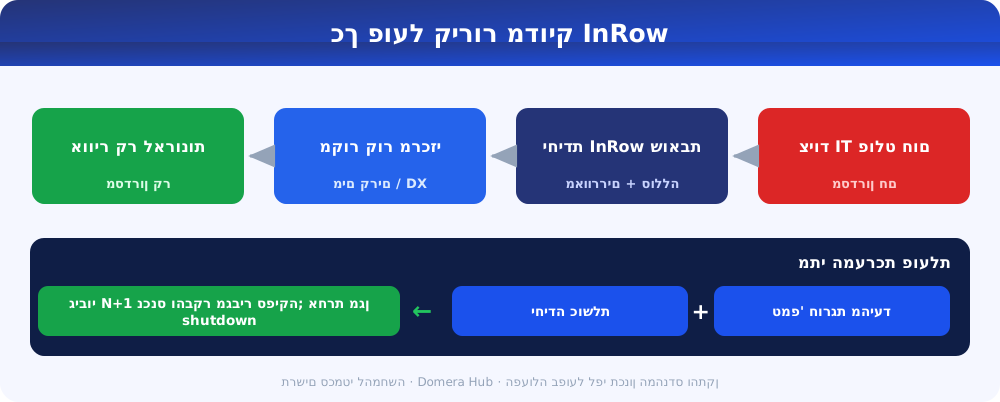
Precision Cooling differs from ordinary comfort air conditioning in three respects: it operates 24/7, it is managed to narrow target temperature and humidity, and it is positioned very close to the heat source. In the InRow configuration the unit is installed between the server cabinets themselves, draws in the hot air exiting the rear of the cabinet (the "hot aisle"), passes it over a cooling coil, and returns cooled air directly to the front of the cabinets (the "cold aisle"). Proximity to the heat source shortens the air path, prevents hot-cold mixing, and greatly improves cooling efficiency compared with a perimeter unit at the edge of the room.
The cooling coil in the InRow unit is usually fed from a central cold source — chilled water supplied from the building chiller, or refrigerant gas in a dedicated DX circuit. Variable-speed fans and a local controller regulate the flow according to the actual heat load, so that the system "breathes" together with IT consumption. In many server rooms several InRow units are installed in parallel in a redundant configuration (N+1), so that the failure of one unit does not bring down the cooling of the entire room. This combination — in-row cooling, humidity management, and a continuous power supply from the UPS system — is what allows the server room to operate continuously and safely.
Why the System Is Needed + Risks of Neglect
Servers do not tolerate heat. A rise of a few degrees above the target range shortens component life, increases failures, and above a certain threshold triggers an automatic protective shutdown — that is, a halt in activity. Because heat accumulates continuously, a cooling failure is not an "inconvenience" but a countdown: in a crowded room the temperature may cross the threshold within just a few minutes.
Neglecting the maintenance of an InRow unit creates a chain of risks: clogged filters choke the airflow and raise the supply temperature; a chilled-water leak or un-drained condensation may cause electrical damage next to sensitive equipment; humidity that is too high promotes condensation and corrosion, while humidity that is too low increases the risk of electrostatic discharge; and a fan or compressor that has not been serviced fails exactly when the load is at its peak. The business result — downtime, data loss, and sometimes irreversible damage to expensive hardware. The value of preventive maintenance here is not "comfort" but operational continuity.
The Maintenance Regime — What, How Often, and How
According to the PPM matrix, periodic servicing of the InRow units is performed at a semi-annual frequency (every 6 months), and is certified by a certificate from the maintaining company. This action is defined as recommended (an operational best practice) and not as a legal requirement — but in a server room the practical meaning of skipping it is a direct risk to operational continuity, and therefore it is treated as an operational obligation for all intents and purposes.
A typical semi-annual service includes, according to the manufacturer's guidance and the current standard: cleaning or replacing filters; cleaning the cooling coil; checking fans, motors and bearings; checking gas/water levels in the cooling circuit and detecting leaks; checking the condensate drain and the drain pan; calibrating temperature and humidity sensors; checking the unit controller and target parameters; and verifying the redundancy mechanism (switchover between N+1 units). Beyond proactive servicing, a well-managed server room continuously monitors temperature, humidity and the units' status, in order to detect deviations before they become a fault.
Who Is Authorized to Maintain and Certify
The party authorized to service and issue a certificate for the InRow units is the maintaining company — a service contractor specializing in precision cooling / data centers, usually holding certification or authorization from the unit manufacturer. The certificate is issued as a "maintaining-company certificate" at the end of each semi-annual service, and it is the document that the maintenance manager keeps as proof that the service was performed. It is important to distinguish: the central source feeding the unit (for example the chiller) is maintained according to its own regime and licensed parties — see the chiller and air-conditioning guide; this article deals with the precision cooling unit itself.
Standards and Regulation
Servicing the InRow units does not rely, within the PPM matrix, on a dedicated Israeli Standard or on an explicit statutory legal requirement — it is classified as a recommended maintenance action. This means the maintenance is carried out according to the manufacturer's guidance and the current standard and according to accepted professional practice for data-center cooling, and not according to a standard number set in law. That said, adjacent components may indeed carry their own compliance requirements: the water or gas circuit, the power source, and the room's fire-safety systems — each is subject to its own regime and standard. It is therefore correct to treat InRow maintenance as part of the overall server-room maintenance, and not as an isolated item.
Required Documentation and Forms
This regime has no dedicated fire form and no mandatory standards document. The operationally binding document is the certificate from the maintaining company, received at the end of each semi-annual service — it should be filed, with the service date and the next service date recorded, and the service report attached (list of filters replaced, temperature/humidity readings, defects corrected). Consistent documentation is what makes it possible to demonstrate a maintenance chain to management, insurers and auditors, and also what makes it possible to identify trends (for example a gradual decline in performance) over time.
Common Faults and Warning Signs
- Temperature rise in the cold aisle / controller alarms — usually clogged filters, a weak fan or a drop in chilled-water flow.
- Humidity outside the target — condensation on equipment (high humidity) or a static-discharge risk (low humidity); a sign of a regulation problem or an uncalibrated sensor.
- Water under the unit / a full drain pan — a clogged condensate drain or a leak; especially dangerous near power and equipment.
- Abnormal noise or vibration from a fan/compressor — bearing wear; a precursor to failure if not addressed.
- A unit that does not come up in redundancy (N+1) — endangers continuity exactly at the moment of failure; discovered only by a proactive redundancy test.
- Ice on the cooling coil — a lack of airflow or a regulation fault; severely impairs cooling.
The rule in the field: in a server room every temperature or humidity alarm is an urgent event, not background noise. A quick response prevents a shutdown and hardware damage.
The Value of Professional Maintenance Management / How Domera Helps
Precision cooling is exactly the kind of system that falls between the cracks: it has no fire form that compels it, but a failure in it halts the digital building. Domera manages it as an item in the PPM program — one open instance per program at any moment, its closing conditional on the maintaining-company certificate uploaded to the system, an automatic reminder before the next service date, and every certificate and service report kept and linked to the asset. Thus the maintenance manager always knows when it was serviced, who certified it and when the next one is due — and produces an orderly compliance report at the click of a button.
Frequently Asked Questions
What is InRow precision cooling and how does it differ from an ordinary air conditioner?
An InRow unit is a dedicated air conditioner positioned between the server cabinets, operating 24/7, and regulating temperature and humidity to a narrow, fixed target range. An ordinary comfort air conditioner is intended for people, not for sensitive equipment, and does not maintain the precision and continuity that a server room requires.
How often must an InRow unit be maintained?
According to the PPM matrix — periodic servicing at a semi-annual frequency (every 6 months), with a certificate from the maintaining company at the end of each service. Beyond that, continuous monitoring of temperature, humidity and the units' status is recommended.
Who is authorized to maintain and certify?
The maintaining company — a service contractor specializing in precision cooling / data centers, usually holding authorization from the unit manufacturer. The certificate it issues is the document filed as proof of performance.
Is InRow maintenance a legal requirement?
In the matrix it is classified as a recommended action and not as a statutory requirement, and it is performed according to the manufacturer's guidance and the current standard. In practice, in a server room, skipping it directly endangers operational continuity, and therefore it is treated as an operational obligation.
What is the relationship between the InRow, the UPS and the chiller?
The chiller or the gas circuit supplies the cold that the InRow unit distributes; the UPS ensures that power to the room (and sometimes to the cooling as well) is not interrupted. The three together allow the server room to operate continuously; a failure in any of them affects the others.
What happens if an InRow unit fails?
If there is redundancy (N+1), another unit should carry the load. Without proper redundancy, the room temperature climbs rapidly to a protective shutdown of the servers or hardware damage — which is why testing the redundancy mechanism is an important part of the service.
What are the warning signs to watch for between services?
A temperature rise in the cold aisle, humidity deviation, water under the unit, abnormal noise/vibration from a fan or compressor, and ice on the cooling coil. Each of these warrants an immediate call to the maintaining company.
Further Reading
- Managing a server room and data center in a building — the overall picture of IT infrastructure: power, cooling, safety and continuity.
- Chiller and air-conditioning maintenance in offices — the central cold source that feeds the InRow units and its maintenance regime.
- UPS — the continuous power supply without which both the cooling and the servers stop.
- The complete PPM guide — how to slot every system, including the InRow, into an annual preventive-maintenance program.
- Domera Knowledge Hub — all the building-systems guides in one place.
Frequently asked questions
What is InRow precision cooling and how does it differ from an ordinary air conditioner?
An InRow unit is a dedicated air conditioner positioned between the server cabinets, operating 24/7, and regulating temperature and humidity to a narrow, fixed target range. An ordinary comfort air conditioner is intended for people, not for sensitive equipment, and does not maintain the precision and continuity that a server room requires.
How often must an InRow unit be maintained?
According to the PPM matrix — periodic servicing at a semi-annual frequency (every 6 months), with a certificate from the maintaining company at the end of each service. Beyond that, continuous monitoring of temperature, humidity and the units' status is recommended.
Who is authorized to maintain and certify?
The maintaining company — a service contractor specializing in precision cooling / data centers, usually holding authorization from the unit manufacturer. The certificate it issues is the document filed as proof of performance.
Is InRow maintenance a legal requirement?
In the matrix it is classified as a recommended action and not as a statutory requirement, and it is performed according to the manufacturer's guidance and the current standard. In practice, in a server room, skipping it directly endangers operational continuity, and therefore it is treated as an operational obligation.
What is the relationship between the InRow, the UPS and the chiller?
The chiller or the gas circuit supplies the cold that the InRow unit distributes; the UPS ensures that power to the room (and sometimes to the cooling as well) is not interrupted. The three together allow the server room to operate continuously; a failure in any of them affects the others.
What happens if an InRow unit fails?
If there is redundancy (N+1), another unit should carry the load. Without proper redundancy, the room temperature climbs rapidly to a protective shutdown of the servers or hardware damage — which is why testing the redundancy mechanism is an important part of the service.
What are the warning signs to watch for between services?
A temperature rise in the cold aisle, humidity deviation, water under the unit, abnormal noise/vibration from a fan or compressor, and ice on the cooling coil. Each of these warrants an immediate call to the maintaining company.